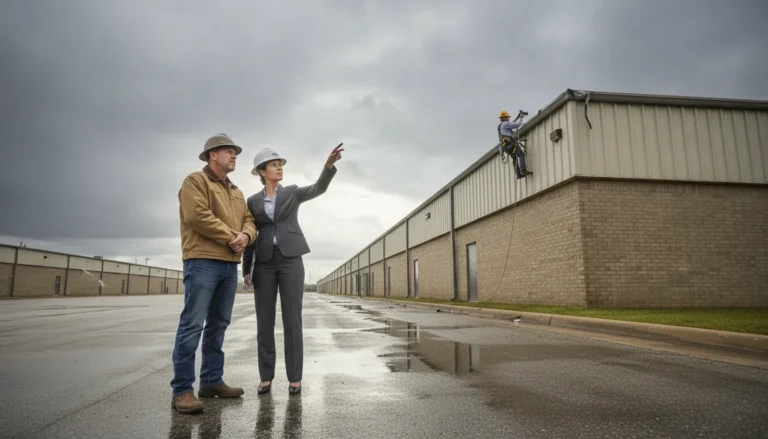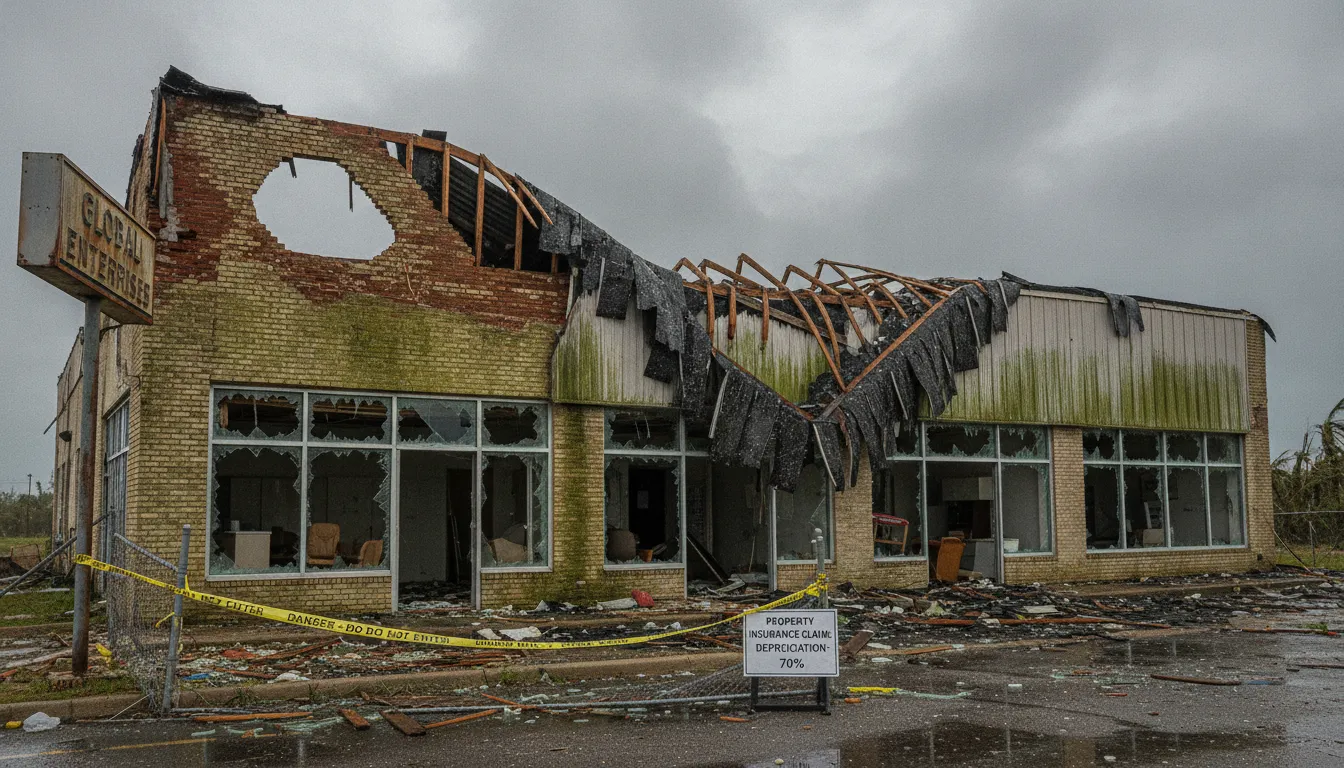
Receiving a low insurance check after a major storm is a blow for North Texas business owners. The payout gap often comes down to depreciation, which can cost you thousands in commercial property insurance claims.
Commercial property insurance claim depreciation is the value an insurer takes away from your payout based on the age and wear of your damaged business property. Most Texas policies use a formula where the actual cash value of an item equals its full replacement cost minus this specific amount of wear and tear. For example, if a ten year old roof has a twenty year life, the carrier may only pay for half of its value at first. As shown by the Texas Department of Insurance, replacement cost coverage should pay the full amount to replace your property with new items. However, firms often hold back part of the funds until you show proof that the work is complete. Knowing these rules is vital to getting your business back on its feet.
You may feel that your carrier is treating you unfairly by keeping your money. To get your full payout, you must learn how your policy defines wear and tear. What Is Depreciation and How Does It Affect Commercial Insurance Claims? explains why. The path begins with.
Commercial Property Insurance Claim Depreciation: What Is Depreciation and How Does It Affect Commercial Insurance Claims?
When you file a commercial property insurance claim, the payout often depends on depreciation. Depreciation is the drop in value of your property due to age and wear. Most business owners in Texas assume their policy covers the full cost of repairs. But the final check might be smaller than the actual repair bill if the insurer applies depreciation to the claim.
How depreciation works in Texas
The Texas Department of Insurance defines how carriers must value property. Most claims use one of two standards. Actual cash value (ACV) is the most common starting point. This pays for the item based on its worth right before the loss. To find this, the insurer takes the replacement cost and subtracts depreciation. If you have a replacement cost value (RCV) policy, the insurer might still hold back depreciation until you finish the repairs.
The math of depreciation
Insurers often use a simple method called straight-line depreciation to calculate your payout. This formula divides the cost of an item by its expected life and then multiplies by the years you have used it. For example, a commercial roof might have a 20-year lifespan. If it cost $12,000 to install and was 10 years old when it was damaged, the insurer might deduct $6,000 for depreciation. This leaves you with a $6,000 actual cash value payout to start your work.
Why age and condition matter
Your building’s condition at the time of the loss plays a big role in your check. A roof that was well-kept will have more value than one that was already failing. Insurers look at the age of the materials to set their prices. This means older buildings in Texas often face higher depreciation rates. If you think the insurer used the wrong age or condition for your property, you may need a lawyer to help you challenge their math.
Recoverable vs. Non-Recoverable Depreciation: What Texas Property Owners Need to Know
Your insurance check may be for less than the cost to fix your building. This happens because most plans use a two-step payment path. The insurer first pays you for the item’s value today. This is the value after you take away wear and tear. If you have the right coverage, you can get the rest of the money back once you finish the work.
The two-payment system is standard for property claims in Texas. The first check is the actual cash value of your loss. The second check is the recoverable depreciation. Both checks cover your full repair cost. This only works if you have a replacement cost policy in place.
How recoverable depreciation works
Recoverable depreciation is the money your insurer holds back until you finish your repairs. This system helps the insurer make sure you use the funds to fix the building. Once you prove the job is done, they send a second check for the held-back amount. Most commercial property insurance claims use this process.
To see how this works, look at a roof that costs $12,000 to replace. If the roof has a 20-year life and is 10 years old, it has lost half its value. The insurer may send you a first check for $6,000. Once you show that you fixed the roof, they send you the other $6,000. This second payment is the recoverable part of your claim.
You must show proof of the work to get this money. This includes bills and receipts from your contractor. You have a right to get the full cost of new materials with the right plan. Without this second check, your business might face a huge bill for the repair work.
When depreciation is non-recoverable
Some policies do not let you get the held-back funds. This is called non-recoverable depreciation. This usually happens if you have an actual cash value (ACV) policy. These plans only pay for what the item was worth at the time of the loss. The Texas Department of Insurance defines ACV as replacement cost minus depreciation.
In these cases, the loss in value is final. You will have to pay the gap between the insurance check and the repair bill yourself. Many business owners choose these plans to save on costs. But they can lead to big costs after a storm. A Texas hail damage claim can be very costly if you have an ACV plan.
Deadlines for Texas property owners
You do not have forever to claim your held-back money. Texas policies often set a strict timeline for these requests. Many plans give you between 180 days and two years from the date of the loss. If you miss this date, you lose the right to the funds. You must track your repair progress and keep every receipt.
Once the work is done, you should file your claim for the rest of the money right away. Do not wait until the last minute. The process to get your second check can take time. If the insurer delays your pay, you may need to talk to a lawyer about your rights under the Texas Insurance Code.
How Texas Insurers Calculate Depreciation on Building Components
Insurance adjusters do not use one number for your whole building. They look at each part of your property on its own. They use a system called straight-line depreciation to find the value of each piece. This helps them decide what to pay you for a commercial property insurance claim after a loss.
The standard math for each component
To find the current value, adjusters start with the price to buy a new item. They then divide that price by how long the item should last. Finally, they multiply that number by the age of the item. This tells them how much value the item has lost over time.
For example, a roof that costs $20,000 to replace may have a 20-year lifespan. If it is 10 years old, it has lost half of its value. The insurer will take $10,000 off your check for that roof. This is why your first check is often much lower than your total repair bill.
Common depreciation schedules for Texas buildings
Each part of a building wears out at its own rate. Texas insurers follow set guides to decide these lifespans. Short-lived items like paint lose value much faster than a concrete base. You must know these rates to ensure your adjuster is being fair. The table below shows common lifespans used for a commercial property insurance claim depreciation check.
| Building Part | Typical Life | Yearly Loss | 10-Year Value |
|---|---|---|---|
| Commercial Roof | 20 years | 5% | 50% ACV |
| HVAC Systems | 15 years | 6.7% | 33% ACV |
| Floors and Paint | 10 years | 10% | 0% ACV |
| Framing and Walls | 40 years | 2.5% | 75% ACV |
Why these rates matter for your claim
Roofs are a common source of high depreciation in North Texas. This is because Texas hail damage claims often lead to full roof jobs. If your roof is near the end of its life, your insurer may hold back a lot of the money. They will only release this cash once you show the work is done.
Some insurers try to use short lifespans on long-lasting items to save money. If an adjuster says your brick walls have a 15-year life, they are likely wrong. You can find more data on how these rules work at the Texas Department of Insurance website. Checking these rates helps you get the full amount you need to fix your business.
How to Recover the Depreciation Holdback in Texas
Most commercial property insurance claim depreciation cases result in two payments. The first check covers the actual cash value of your loss. This amount is your full replacement cost minus a cut for wear and tear. The insurance firm holds onto the left-over funds until you can prove that you finished the work. This held-back money is often called recoverable depreciation.
Finding proof of repair
To get your holdback funds, you must show the firm that you spent the money to fix the building. You cannot just pocket the first check and skip the repairs if you want the full payout. The Texas Department of Insurance explains that actual cash value covers the item’s current worth. In contrast, replacement cost coverage pays to make the property new again. If your policy has this coverage, you have a right to the full sum once the job is done.
- Complete all repairs. You must finish the work as listed in the claim quote to get the full holdback payment.
- Gather bills and builder records. Keep a clear file of all costs, proof of payment, and photos showing the finished work.
- File a new request. Send a formal letter to your adjuster to ask for the release of the held funds.
- Meet all policy deadlines. Check your policy for the time limit to finish repairs, which often ranges from six months to two years after the loss.
- Get a third-party quote. If the firm claims your costs were too high, you may need an expert to show the fair price of the work.
Meeting insurance deadlines
Time is a major factor in commercial property insurance claims. If you miss the deadline to finish repairs, you may lose the right to the held funds for good. Most Texas policies give you at least 180 days, but some give you much longer. You should always check the exact date in writing with your adjuster early in the process. Do not wait until you finish the work to find out the time has run out.
In many cases, the cost to fix your roof or HVAC system is higher than the firm first quoted. This often happens with hail damage claims where prices for goods go up fast. If your builder finds more damage or higher costs, you must tell the firm right away. They may need to update the claim before you finish the work to ensure you get paid in full.
When to seek legal help
Insurance firms often try to hold onto as much money as they can. They might apply too much depreciation to your claim or refuse to release funds for small reasons. If the firm denies your request for the holdback, you may need a lawyer. An expert who knows Texas law can help you fight for the full value of your policy. You should not have to pay for covered repairs out of your own pocket when you have the right coverage.
When Depreciation Deductions Can Be Legally Challenged in Texas
Insurance companies often take depreciation for granted. They assume every owner and property insurance attorney will accept their math as final. But Texas law offers several ways to fight back if a carrier cuts your check too deep. You do not have to take an unfair value for your site damage. In many cases, you can challenge how the insurer took these cuts from your payout.
The Difference Between Repair and Replacement
One of the best tools for Texas business owners is the “partial loss” rule. Texas case law has found that insurers should not take depreciation when a loss is only partial. If your building needs repairs rather than a full swap of a major system, the insurer may be wrong to deduct value for age. For example, a storm might damage part of a roof but not destroy the whole structure. In this case, you may be able to claim the full repair cost.
Carriers often try to treat every repair as a step toward a new building. They use this to give themselves a reason for lower payouts. But if the work only restores the building to its state before the loss, depreciation may not apply. This diff can save a business tens of thousands of dollars on a large claim. A lawyer can review your plan to see if the insurer used these rules the right way.
Challenges to Labor Depreciation
Another common point of conflict is labor depreciation. Most people agree that physical goods like wood or tile lose value as they get old. However, the value of labor does not drop in the same way. A worker’s time and skill cost the same today whether the building is five years old or twenty years old. Many experts argue that insurers should only take depreciation on the cost of goods, not the cost of the work itself.
While some insurers still try to deduct for labor, this practice is shaky in Texas law. It often leads to a “double dip” where the insurance company saves money at your expense. If your claim summary shows a big cut for labor, you may have grounds for a legal challenge. You can find more about how insurers must value your property on the Texas Department of Insurance website. These rules help ensure you get a fair deal for your repairs.
Texas Insurance Code and Fair Claims Handling
The Texas Insurance Code sets strict rules for how carriers must handle your claim. It requires companies to act fairly and avoid lying about policy terms. An insurer cannot use complex math to trick you into a lower payout. They also cannot cause long delays without a good reason. If a carrier uses too much depreciation to avoid paying what they owe, they may be breaking these state laws.
Challenging a multi-billion dollar insurance company is hard for most business owners. These companies have teams of workers and lawyers who work to keep costs down. Getting an independent estimate is often the first step in a successful challenge. This provides a clear contrast to the insurer’s low value. By using state laws and clear facts, you can push for the full amount needed to get your business back on its feet.
Other Policy Coverages That Interact with Depreciation
A commercial property insurance claim often involves more than just physical damage to a building. While depreciation is a major factor for bricks and mortar, other parts of your policy work differently. You should know how your coverage for business income and code updates treats value loss.
Business interruption and income loss
Business interruption coverage helps replace lost profit when your doors must stay closed after a fire or storm. This part of your claim is not usually subject to commercial property insurance claim depreciation because it pays for lost time and money, not physical goods. The payout is based on your past financial records and expected earnings during the time you are out of work.
Insurers look at your net income and fixed costs to find the right payout amount. Since this covers a service or a flow of cash, there is no physical wear to deduct. You can find more details on how these payments work by visiting our page on business interruption claims for Texas owners.
Ordinance or law coverage
When you rebuild an older building, you may have to follow new local building codes. These laws often require more costly materials or safer designs than the original structure had. Standard policies may only pay to put the building back to its old state, which is where ordinance or law coverage becomes vital.
This coverage pays for the extra cost of meeting current codes. Because these costs are for new items required by law, they are often handled as a separate pool of funds. This ensures that the gap created by depreciation on your old building does not stop you from meeting new safety rules. The Texas Department of Insurance notes that replacement cost policies are the best way to handle these rising building costs.
Extra expense and loss of rents
Extra expense coverage pays for the costs of keeping your business running at a temporary site. This might include rent for a new space or the cost to move equipment. Loss of rents covers the money a landlord loses when tenants cannot stay in a damaged unit. Like business income, these are financial losses rather than physical property.
Since these coverages pay for actual costs you pay or rent you lose, they do not face a depreciation holdback. You are paid for the real dollar amount of the loss or the extra spend. Understanding these distinctions helps ensure your full claim is paid without unfair cuts from the insurance company.
Frequently Asked Questions
How do I recover depreciation withheld on a Texas commercial property claim?
You can get back the money held by your insurer by finishing all repairs. You must send proof of the work, like bills and receipts from your contractor, to the insurance company. The Texas Department of Insurance says that replacement cost coverage pays the full price to fix or replace property. After the work is done, you file a final claim to get the rest of your money.
Can Texas insurance companies depreciate the cost of labor?
Insurance companies often try to lower their costs by cutting the value of labor. However, many owners challenge this in court. Unlike building materials, the cost of work does not lose value due to age. Many people argue that insurers should only apply these cuts to physical items like wood or metal. If your insurer cut your pay by doing this to labor, you should have an expert look at your claim. These cuts can make it hard to start repairs.
Is depreciation deducted from partial commercial property losses in Texas?
Texas case law says that insurers should not take depreciation for partial losses that only need repairs. If a storm damages a small part of your building, the cost to fix it should be paid in full. This rule helps owners get enough money to cover their real repair costs. You should check your papers if your insurer took out money for depreciation on a partial loss claim in Texas. This could be an unfair cut to your pay.
What happens if I miss the deadline to claim recoverable depreciation?
If you miss the deadline, you will likely lose the right to get the withheld money. Most Texas policies give you between 180 days and two years to finish repairs and ask for the funds. If you fail to meet this time limit, the insurance company gets to keep the money. You should always read your policy to find your exact date. If the insurer is slow to help you, you may still have a way to get paid.
Ready to challenge your insurance company’s depreciation math?
Waiting too long to file your claim can cost you the money your insurance company held back. Texas commercial policies have strict deadlines that can end your right to get a full payout. Many owners do not know they can challenge a low check based on bad math. Acting now lets you get a fair review of your loss before time runs out. Taking this step helps you protect your business and get the full cash value you need to move forward. You can contact our property insurance lawyers who know how to find errors in claim reports and fight for the real value of your commercial building.
Ready to protect your claim? Call (817) 731-9703 to schedule a free consultation with our legal team today.