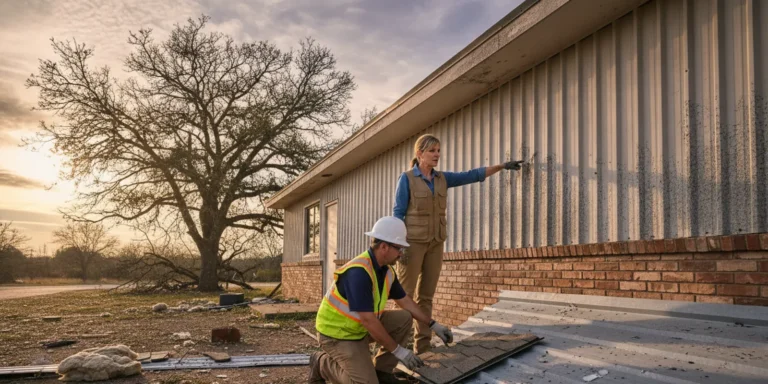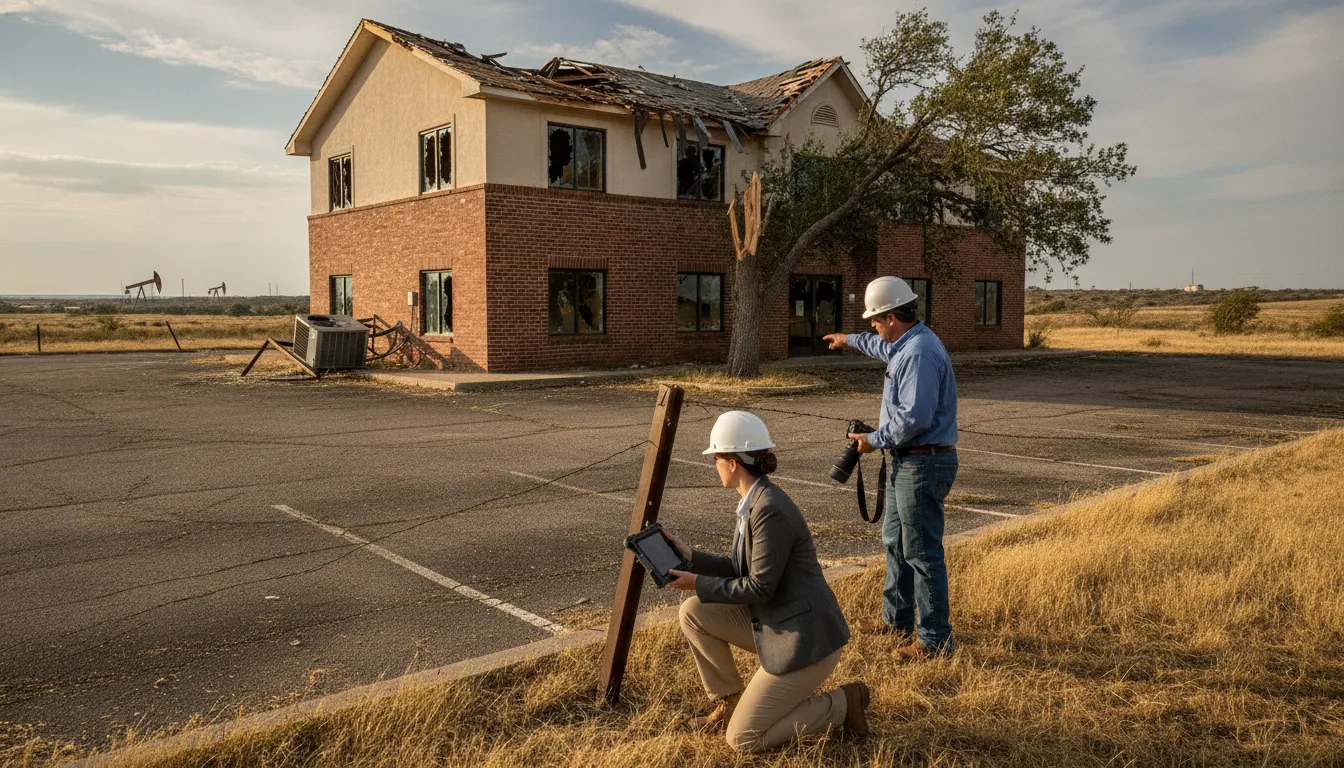
When a Texas business suffers roof, fire, storm, or other covered property damage, the insurer’s first payment may be far less than the cost to restore the building. One common reason is depreciation, which adjusters use to account for age and wear when calculating the property’s value at the time of loss.
Commercial property insurance depreciation Texas claims are often calculated by subtracting the estimated loss in value from the property’s replacement cost. That reduction lowers the initial Actual Cash Value payment, but the policy language, the item being depreciated, and the available replacement-cost benefits all matter. An insurer cannot simply apply an unsupported schedule and treat the result as final.
Understanding the difference between a legitimate valuation adjustment and an improper reduction starts with the basic terms in your policy. It also requires looking closely at how the carrier defines depreciation and applies it to each damaged component.
Commercial Property Insurance Depreciation: The Short Answer
Commercial property insurance depreciation is the reduction an insurer applies for age, wear, or condition when calculating actual cash value. If the policy provides replacement-cost coverage, a business may be able to recover withheld depreciation after completing covered repairs, subject to the policy’s terms, deadlines, and proof requirements. The estimate should identify the damaged component, replacement-cost amount, depreciation method, and amount withheld.
What Is Commercial Property Insurance Depreciation in Texas?
Depreciation is the reduction in a property’s value caused by age, wear, and tear. After a covered loss, an insurance company may account for that reduction when calculating what it initially pays to repair or replace damaged commercial property.
The basic formula for actual cash value, or ACV, is replacement cost minus depreciation. The Texas Department of Insurance explains that ACV coverage subtracts depreciation, while replacement cost coverage pays the current cost to repair or replace property without subtracting wear-and-tear depreciation. Read the Texas Department of Insurance commercial property insurance guide for the state’s overview of these coverage options.
For example, suppose a roof would cost $12,000 to replace and has a 20-year expected lifespan. If the roof is 10 years old when a covered loss occurs, a straight-line calculation might assign $6,000 in depreciation, or $600 for each year of age. The remaining actual cash value would be $6,000. However, depreciation schedules and policy language can produce different calculations. The Voss Law example uses a $12,000 roof, a 20-year lifespan, and 10 years of age to reach $5,000 in ACV, showing why the numbers must be checked against the insurer’s methodology and the policy.
That distinction matters because the initial ACV payment may not represent the full amount needed to restore the building. A policy with replacement cost coverage may allow the policyholder to recover withheld depreciation after completing repairs, subject to the policy’s requirements and deadlines.
Insurers also cannot automatically depreciate every part of a claim simply because they label the payment ACV. In a Texas federal court ruling discussed by HKR Law, the court found that an undefined ACV term was ambiguous and interpreted the ambiguity in favor of the policyholder. The ruling addressed whether anticipated labor costs could be depreciated.
Understanding commercial property insurance depreciation in Texas starts with comparing the policy’s coverage type, definitions, depreciation schedule, and claim estimate. A careful review can reveal whether the insurer applied a justified deduction or reduced the payment beyond what the policy allows.
How Insurers Calculate Depreciation on Roofs, HVAC, and Building Components
When an insurer applies depreciation, it reduces the initial payment to reflect the building component’s age and condition at the time of the loss. The calculation should be tied to the damaged item, its expected useful life, and the policy’s coverage terms. It should not be a vague percentage applied to an entire claim.
Roofs: useful life and straight-line depreciation
Roof estimates commonly use a useful-life schedule. Under a straight-line approach, the insurer divides the component’s expected depreciation period into equal annual amounts, then applies the result to the roof’s age. For example, the Voss Law Firm describes a $12,000 roof that is 10 years old with a 20-year useful life. At $500 per year in depreciation, the insurer’s initial actual cash value payment is shown as $5,000, before any deductible or policy adjustments. The example illustrates why the estimate should identify the roof’s age, expected lifespan, replacement cost, and the arithmetic supporting each deduction.
HVAC systems: mechanical schedules and condition
HVAC depreciation is often calculated through a mechanical-equipment schedule rather than the same schedule used for roofing. An adjuster may evaluate the system’s installation date, expected service life, remaining useful life, and condition. A commercial building may also contain separate depreciable components, including rooftop units, compressors, controls, ductwork, and related equipment. Those items should be evaluated individually when their ages, condition, or replacement scope differ. An estimate that assigns one unsupported age or percentage to every HVAC line item deserves scrutiny.
Structural components and labor
Insurers may also depreciate damaged structural components such as siding, exterior finishes, insulation, doors, or other building materials. The policy and the facts of the loss control what may properly be deducted. Labor is especially important in Texas. A federal Texas ruling discussed by HKR Law states that, where the policy did not define actual cash value clearly, anticipated labor costs were not included in depreciation. That does not resolve every claim, but it means an insurer should not automatically depreciate labor without analyzing the policy language and applicable law. See the ruling at HKR Law’s discussion of labor depreciation.
If the policy provides recoverable depreciation, the withheld amount is not necessarily lost. After repairs are completed, the policyholder generally submits proof of completion. And the insurer pays the difference between the initial actual cash value payment and the covered replacement-cost amount, subject to the policy’s conditions and limits.
What to Check in a Commercial Property Depreciation Estimate
Before accepting an insurer’s calculation, compare the estimate with the policy and the condition of each damaged component. Check whether it identifies:
- the damaged item and the scope of repair or replacement;
- the replacement-cost amount used as the starting point;
- the item’s age, expected useful life, and actual condition;
- the depreciation method and arithmetic supporting the deduction;
- any treatment of labor, overhead, profit, sales tax, or other claim costs; and
- the amount of withheld depreciation, the repair deadline, and the documents required to request it.
Keep the estimate, declarations page, endorsements, photographs, invoices, and repair records together. If the carrier has already denied or underpaid the claim, review the calculation against the policy before signing a release.
Manipulative Appraisal Tactics Texas Adjusters Use to Reduce Payouts
Depreciation can be legitimate when a policy calls for actual cash value, but the calculation is not a blank check for an insurer. Adjusters sometimes use technical uncertainty to push a commercial property claim below what the policy requires. Hoch Law Firm’s insurance claim guidance warns that carriers may rely on vague terminology to underpay valid claims. That makes the wording of the policy, the estimate, and the depreciation worksheet equally important.
Depreciating More Than the Policy Allows
One recurring dispute concerns whether overhead, profit, and sales tax can be depreciated. These costs may be part of the amount reasonably necessary to complete covered repairs, yet an insurer may treat them as if they were aging building materials. A Texas case discussed by the Property Insurance Coverage Law Blog addressed whether those replacement costs were subject to depreciation. The answer can depend on the policy language and the governing legal interpretation, so a blanket deduction deserves scrutiny.
Labor is another common pressure point. In a Texas federal court decision, the court explained that when “actual cash value” was undefined. The term was ambiguous and did not include depreciation of anticipated labor costs. The decision is summarized by HKR Law. That does not mean every policy produces the same result, but it does mean an adjuster’s unexplained deduction for labor should not be accepted automatically.
Manipulating Useful Life and Component Categories
An adjuster may assign a shorter useful life than the condition and expected service life of the damaged property reasonably support. A shorter schedule produces faster depreciation and a smaller initial payment. Another tactic is bundling separate components, such as roofing layers, insulation, flashing, and mechanical equipment, under one broad schedule. That can apply an aggressive age assumption to newer or longer-lasting components that should be evaluated separately.
Holding Recoverable Depreciation Hostage
Under replacement-cost coverage, an insurer may owe withheld depreciation after qualifying repairs are completed. Requiring reasonable proof of repair is different from demanding an excessive or shifting set of documents, delaying review, or refusing payment without explaining the policy basis. Preserve estimates, invoices, photographs, permits, and every request from the carrier so the record shows what was submitted and when.
When an ACV term is undefined, Texas courts have recognized that competing reasonable interpretations create an ambiguity resolved in favor of the policyholder. Review the full calculation before accepting a reduced commercial property payout.
Actual Cash Value vs Replacement Cost: Key Differences for Texas Commercial Property
The distinction between actual cash value and replacement cost can determine how much money is available after a covered loss. The Texas Department of Insurance explains that actual cash value coverage pays replacement cost minus depreciation. While replacement cost coverage pays current costs for new materials without subtracting depreciation. Read the full actual cash value vs replacement cost comparison before relying on an insurer’s estimate.
| Feature | Actual Cash Value (ACV) | Replacement Cost Value (RCV) |
|---|---|---|
| Payout basis | Current cost to repair or replace, less applicable depreciation. | Current cost to repair or replace with new materials, subject to policy limits and terms. |
| Depreciation deducted | Yes. Age, wear, and condition can reduce the initial payment. | Generally no deduction for depreciation when the policy’s replacement-cost requirements are met. |
| Premium cost | Often lower than replacement cost coverage. | Often higher because it provides broader reimbursement for new materials. |
| Best for | Businesses seeking lower premiums and willing to absorb depreciation. | Businesses that need stronger funds to restore buildings, equipment, or other covered property. |
| Payout timing | May provide the depreciated amount first. | May pay an initial amount and release withheld depreciation after covered repairs or replacement, as the policy requires. |
| Recoverable depreciation option | Usually limited or unavailable unless the policy includes a specific provision. | Often available when the policyholder completes qualifying repairs and submits required documentation. |
Why the coverage distinction matters
With ACV, depreciation can create a substantial gap between the repair estimate and the initial payment. With RCV, the policy may cover the cost of new materials. But the policyholder still must follow requirements such as timely repairs, proof of work, and any applicable limits. Coverage language controls the result, so the declarations page and endorsements should be reviewed alongside the estimate.
Coinsurance can reduce either payout
Replacement cost coverage does not eliminate the need for adequate limits. Many commercial property policies include an 80% coinsurance rule. If the property is insured for less than the required percentage of its value, the policyholder can face a coinsurance penalty that reduces the claim payment. Confirm the valuation method, policy limit, and coinsurance calculation before a loss, and challenge an estimate that applies depreciation or a penalty inconsistently with the policy.
For definitions of ACV and replacement cost, see the Texas Department of Insurance consumer guidance.
How to Recover Depreciation Withheld From Your Commercial Insurance Claim
Recoverable depreciation is usually released only after you complete the repair or replacement and show the insurer that the work was performed. Follow these steps carefully, because your policy may impose a strict deadline for requesting the withheld amount.
- Confirm that your policy allows recoverable depreciation. Review the valuation language and confirm that the building or damaged property is covered on a replacement cost basis, often called an RCV policy. An actual cash value payment may subtract depreciation permanently, while an RCV policy may allow you to recover it after the work is complete. Check the policy for conditions, exclusions, deductible treatment, and the deadline for submitting your request.
- Complete the repairs or replacement. Use a qualified, licensed contractor and make sure the work addresses the covered damage identified in the estimate. Keep the scope of work, change orders, permits, receipts, and payment records. Do not assume that accepting the initial actual cash value payment closes the claim if the policy provides additional replacement cost benefits.
- Submit proof of completion. Send the insurer clear documentation, including final invoices, photographs of the completed work, receipts for materials, permits when applicable, and a contractor sign-off or completion statement. Organize the documents by damaged component so the adjuster can match the completed work to the original estimate. Keep copies and proof of delivery.
- Request the recoverable depreciation payment in writing. Identify the claim number, date of loss, completed repairs, and exact amount being requested. Deadlines vary by policy, but Texas property policies often allow between 180 days and two years from the loss date to request recoverable depreciation, according to Lloyd Law Firm. Do not wait until the deadline is close. For example, the Voss Law example describes a $12,000 roof with a $5,000 initial actual cash value payment and $5,000 in recoverable depreciation released after repairs.
- Address delay or denial promptly. If the insurer stops responding, demands documents you already provided, or refuses payment without a policy-based explanation, preserve every communication and request the specific reason in writing. Review your options under the Texas Prompt Payment of Claims Act, which may provide remedies when an insurer improperly delays payment of a valid claim.
- Contact a Texas insurance attorney when the insurer refuses to pay. An attorney can compare the policy, estimate, repair records, and payment history to determine whether the insurer improperly withheld depreciation or applied an invalid condition. Early review can also help protect deadlines and preserve evidence before the dispute becomes harder to resolve.
When to Contact a Texas Commercial Property Insurance Claim Lawyer
Commercial property owners should consider legal help when an insurer’s depreciation calculation appears designed to reduce the claim rather than reflect the property’s actual condition. Depreciation can be legitimate when it accounts for age and wear, but an unsupported schedule, unexplained adjustment, or delay in releasing withheld funds deserves scrutiny. These warning signs often indicate that the carrier is applying the policy in the most restrictive way possible.
Warning signs in the insurer’s calculation
- Unreasonable schedules for older components: The insurer assigns an unusually short useful life to a roof, HVAC system, or structural component, creating excessive depreciation without explaining the basis for the schedule.
- Recoverable depreciation is denied or delayed: You complete covered repairs, provide reasonable proof, and the carrier still refuses to release the withheld amount or gives no valid reason for the delay.
- Vague policy language is used to justify underpayment: An adjuster relies on broad references to “actual cash value” or policy exclusions without showing how the language supports the specific deduction. Texas courts have recognized that an undefined ACV term may be ambiguous, and disputes may include whether labor costs can be depreciated.
- Labor costs are depreciated: A carrier subtracts depreciation from anticipated labor costs. A Texas federal court ruling addressed this practice and concluded that the applicable policies did not include depreciation of anticipated labor costs. Review the policy and claim calculation with counsel before accepting that deduction.
- Excessive documentation is demanded: The insurer keeps requesting increasingly burdensome records before releasing recoverable depreciation, even after you have supplied invoices, contracts, permits, or other reasonable proof of repair.
These tactics can affect more than the building repair itself. A delayed or reduced payment may interrupt operations, equipment replacement, payroll, and other expenses. Owners should also evaluate whether business interruption insurance responds to resulting losses.
Hoch Law Firm has experience countering bad-faith depreciation tactics and challenging claim positions that do not match the policy or Texas law. Tim Hoch can review the policy, adjuster’s estimate, depreciation schedule, repair records, and communications to identify what the insurer deducted and why. The firm serves commercial policyholders across Texas and works to level the playing field against powerful carriers.
Policyholders who suspect unfair depreciation should have their policy reviewed by an experienced Texas attorney.
Frequently Asked Questions
What is actual cash value in Texas commercial property insurance?
Actual cash value, or ACV, generally means the cost to repair or replace damaged property minus depreciation for age and wear. The Texas Department of Insurance explains that depreciation reflects a property’s decrease in value over time. Texas Department of Insurance guidance can help you identify which valuation method your policy uses.
How does depreciation affect my Texas commercial property insurance claim?
An insurer may subtract depreciation from the initial payment based on the damaged property’s age, condition, and expected useful life. That calculation can substantially reduce the money available for immediate repairs, particularly when the adjuster applies an aggressive schedule or depreciates costs the policy or Texas law may not allow.
What is the difference between replacement cost and actual cash value in Texas?
Replacement cost coverage generally pays the current cost to repair or replace covered property with new materials, without subtracting depreciation. ACV coverage subtracts depreciation from that replacement cost. Your declarations, endorsements, and policy conditions determine which valuation applies and what proof is required before payment.
Is depreciation always deducted from my commercial property claim in Texas?
No. Some commercial policies provide replacement cost coverage or allow recoverable depreciation. Other policies may limit recovery based on repair deadlines, valuation terms, or property conditions. The insurer must apply the policy language correctly, and disputed labor depreciation may depend on whether the policy clearly defines actual cash value.
Can I recover depreciation withheld from my commercial insurance payout?
Often, you may be able to recover withheld depreciation if the policy includes recoverable depreciation and you complete the required repairs or replacement. Keep contracts, invoices, photographs, and completion records, then submit them before the policy deadline. If the insurer refuses payment or applies an unsupported deduction, have the adjustment and policy reviewed promptly.
Schedule a Consultation About Your Commercial Property Claim
Depreciation disputes can turn a covered loss into a payment that does not reflect the work your business needs. A careful review can help clarify how the insurer calculated the payout and whether the adjustment follows the policy. Hoch Law Firm represents Texas commercial property owners in insurance disputes and can review the policy, estimate, depreciation schedule, and repair records.
Call 817-731-9703 to schedule a free consultation about your commercial property insurance claim.