If you were injured on someone else’s property, you may be asking whether the owner or another party can be held responsible. A premises liability lawyer Texas residents consult can review how the injury happened, who controlled the area, and what evidence may clarify the events. An injury alone does not establish legal responsibility; the specific condition and circumstances matter.
Contact Hoch Law Firm to discuss your situation
What does premises liability mean in Texas?
Premises liability is a general term for legal issues involving an injury connected to property or a condition there. Incidents can occur in a store, apartment complex, office, parking area, or another setting. The property owner is not automatically responsible whenever a visitor is hurt. An initial review may ask who controlled the place, why the injured person was there, what caused the injury, and what the responsible party knew or reasonably could have discovered.
Examples of conditions include a slippery surface, broken stair, uneven walkway, poor lighting, or an object left in a passage. These examples do not prove a claim. A fall may have more than one possible explanation, and a condition may be repaired or changed soon after an incident. Evidence about the scene and timing can therefore be important.
Different rules may apply depending on the relationship between the injured person and the property controller and whether the injury involved a condition or an activity. Do not assume that a general article determines how a particular event is classified. Details such as permission to enter, the purpose of the visit, and the place involved may affect the analysis.
Which facts may affect a premises liability claim?
A careful review starts with a clear description of the event, without guessing about facts that are not known. These questions can help organize that account:
- Where did it happen? Identify the exact area, such as a stairwell, entrance, aisle, parking lot, or shared hallway.
- Who controlled or maintained that area? An owner, tenant, management company, or another party may have different responsibilities depending on the arrangements.
- What condition or activity preceded the injury? Describe what you saw and did, separating direct observations from assumptions.
- When may the condition have appeared? Witness observations, earlier complaints, inspection records, or photographs may help establish a timeline.
- Were there warnings or barriers? Note where they stood and whether they were visible along the route you took.
- What happened afterward? Record the report, medical care, symptoms, and practical effects such as missed work.
Notice can be an important issue. A review may consider what a property controller actually knew, what a reasonable inspection might have revealed, and what action followed. The relevant evidence depends on the situation. A warning sign, for example, should be considered in context: where it was placed, what it warned about, and whether it addressed the condition.
Texas law is fact-specific. The Texas Legislature’s official statutes website provides access to state statutes, but an online statute search is not a substitute for applying law to an individual event. A lawyer can identify which legal provisions and decisions may be relevant to the facts.
What should you do after an injury on property?
- Get appropriate medical care. Your health comes first. Tell your provider what happened and describe your symptoms. Follow the care instructions you receive and keep copies of relevant records.
- Report the incident when appropriate. Tell the owner, manager, or staff. Ask how the report is recorded. Note the date, time, and name of the person you spoke with, and keep any report or reference information provided.
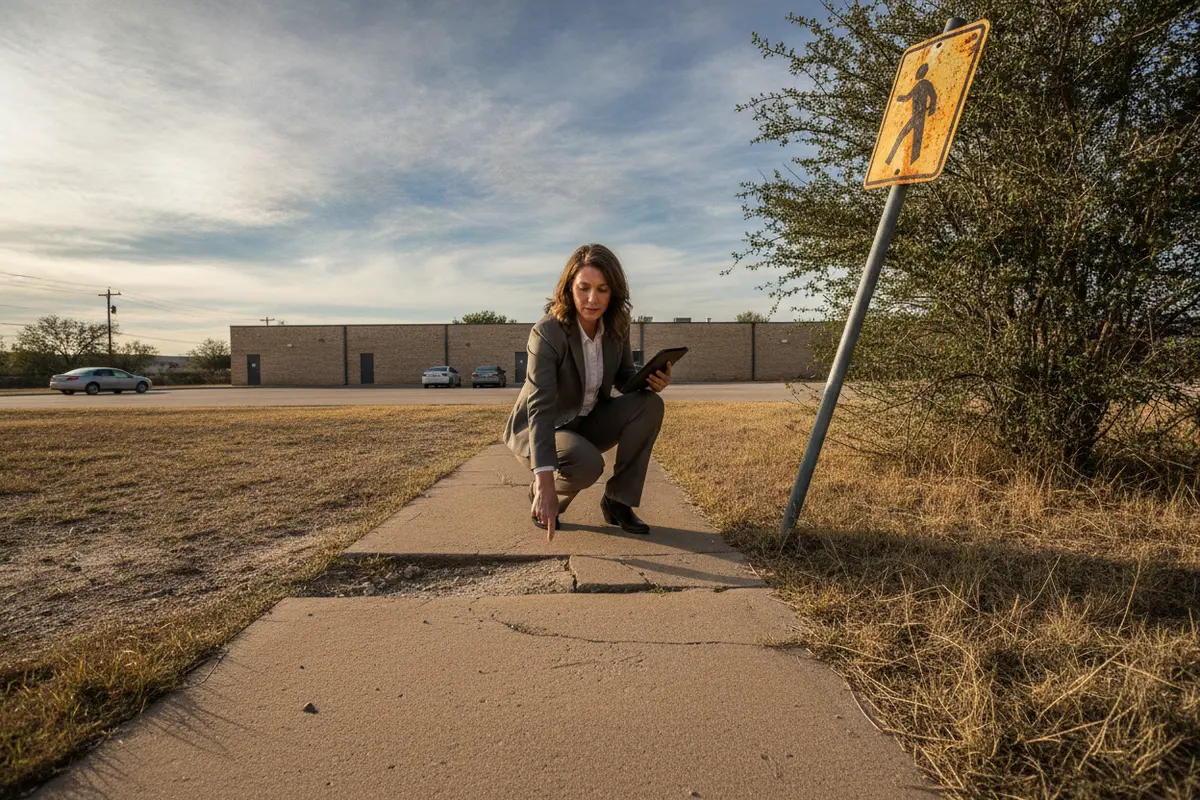
- Document the scene if it is safe. Photograph the condition, surrounding area, lighting, warnings, and the route you used. Take both close views and wider images that show context. Do not trespass or put yourself at risk.
- Identify witnesses. Write down names and contact details for people who saw the event or condition. Note what each person observed, without coaching them or asking them to adopt your interpretation.
- Preserve records and objects. Keep incident paperwork, messages, receipts, medical records, and notes about symptoms or time away from work. If clothing or footwear may be relevant, do not alter or discard it before asking how to preserve it.
- Be thoughtful about forms and statements. Give accurate information, but do not guess when you do not remember. Read documents before signing and consider asking a lawyer about a recorded statement or release.
Some conditions are repaired quickly. A business may also keep video or other records for a limited period. Prompt, accurate documentation can preserve details for later review. Do not interfere with a property or try to obtain records without permission. A lawyer can discuss appropriate preservation requests.
How can you build a useful timeline?
Write down the sequence while your memory is fresh. Include when and where you arrived, the route you took, what you noticed before the event, what happened immediately afterward, and when you reported it. Record the names of people present and when you sought medical care. Mark which details come from your own memory and which come from a document or another person.
A simple timeline can distinguish known facts from open questions. For instance, you may remember seeing liquid on the floor after a fall but not know when it appeared. Write that plainly. Do not turn an inference into a fact by stating that the liquid had been there for a particular period unless you have a reliable basis for saying so.
Keep original photographs intact. If you make a copy for annotation, preserve the original separately. Date later notes and identify when you wrote them. Store correspondence, reports, bills, and medical material in separate folders. Organization helps a lawyer see what is established and which records may need to be requested or checked.
Which records may help answer key questions?
The likely sources vary by property and incident. The comparison below is a practical starting point, not a promise that any particular record exists or will establish responsibility.
| Record or information | Question it may help answer | Possible source or next step |
|---|---|---|
| Scene photographs or video | What did the condition, lighting, and surrounding layout look like? | Your documentation; ask promptly about preserving relevant business footage |
| Incident report and messages | When was the event reported, and what was recorded? | Property staff, management, or your own files |
| Inspection and maintenance records | What inspections, repairs, or prior observations were documented? | Owner, tenant, or manager; legal process may be needed |
| Witness accounts | What did another person observe before or after the event? | Witness contact information and a dated account |
| Medical and expense records | What care and costs followed the injury? | Providers, insurers, receipts, and personal records |
A photograph can show what a condition looked like at one moment, but may not show how long it existed or who had responsibility for the area. Likewise, an incident report can record an account without resolving disputed facts. Records should be considered together and in context.
How should you compare the issues that need investigation?
It can help to separate the core questions instead of treating the event as one general dispute. The following examples show how the same incident can raise distinct lines of inquiry.
- Condition: What exactly caused the injury? A close photograph may show a surface detail, while a wide view may reveal the route, lighting, and nearby warnings.
- Control: Which party maintained or managed the location? A tenant may occupy a space while a separate company maintains shared areas. The relevant documents and actual practices may matter.
- Notice: Was the condition reported or observed before the injury? A witness or maintenance record may be more useful on timing than a later image alone.
- Response: Was the area inspected, repaired, blocked off, or marked? The response and its timing may need to be compared with the evidence about the hazard.
- Injury and effects: What treatment and other losses followed? Medical documentation and dated expense records can provide detail, while the legal significance depends on the individual case.
Consider a hypothetical visitor who slips near an entrance. A scene image might establish that the floor was wet after the incident, but not when it became wet. A witness who saw the condition earlier, an inspection log, or a report to staff could add timing information. Separately, records may be needed to determine which entity handled that entrance. This is why preserving several types of evidence is often more useful than relying on one item.
For background on the firm and its litigation work, see the information about personal injury matters, practice areas, and Tim Hoch’s qualifications. Tim Hoch is Board Certified in Personal Injury Trial Law. No credential or prior result guarantees a particular outcome.
What should you know about insurance and deadlines?
An insurance representative may ask for an account, documents, or a recorded statement. Keep a note of the representative’s name, company, date, and request. Save correspondence and ask for time to review paperwork you do not understand. Before signing a release or giving a recorded statement, consider getting legal advice about the request and its potential effect.
Insurance coverage and legal responsibility are separate questions. The existence of a policy does not itself establish that a property controller was responsible, and policy terms may affect how a claim is handled. Do not assume that an insurer’s position resolves every issue. Keep communications factual and avoid speculating about details you cannot recall.
Legal deadlines and notice requirements can depend on the parties and circumstances. A general article cannot calculate a deadline for an individual matter. If a response date is approaching or evidence may be lost, seek advice promptly. Preserve the documents you have and share any letters that include a date or deadline with counsel.
When may a premises liability lawyer in Texas help?
Legal guidance may be useful when an injury is serious, the cause is disputed, the condition has changed, several parties may have controlled the location, or an insurer requests a statement or release. A lawyer can review available information, identify gaps, discuss possible next steps, and explain timing concerns. The analysis depends on the facts; a consultation does not guarantee that a claim can be brought or that it will succeed.
Hoch Law Firm handles complex litigation and selectively accepts cases. To make an initial discussion more focused, gather the incident date and location, a brief account of what happened, names of witnesses, available photographs, and any report or correspondence. Do not postpone urgent medical care to collect paperwork.
Additional background is available in the firm’s overview of personal injury law firms and its questions to consider when seeking legal help. These materials provide general information and do not resolve the facts or law of a particular situation.
Frequently Asked Questions
Does an injury on someone else’s property automatically mean the owner is liable?
No. An injury alone does not establish liability. The condition, control of the area, notice, warnings, and circumstances of the visit may all matter. The facts need individual review.
What should I preserve after a fall?
When safe, keep scene photographs, witness contact details, incident paperwork, communications, medical records, and expense documents. Write a dated timeline and preserve original images and potentially relevant items.
Should I sign an insurance release?
Do not sign a document you do not understand. A release may affect rights, so consider asking a lawyer to review it before you agree. Keep a copy of all documents and communications.
How quickly should I ask for legal advice?
Consider acting promptly because evidence can change or become harder to obtain and deadlines may apply. A lawyer can discuss timing based on the facts; this article cannot calculate a deadline for you.
Contact Hoch Law Firm to discuss the incident
Careful documentation and timely, informed advice can help you understand which questions to address after an injury on property.