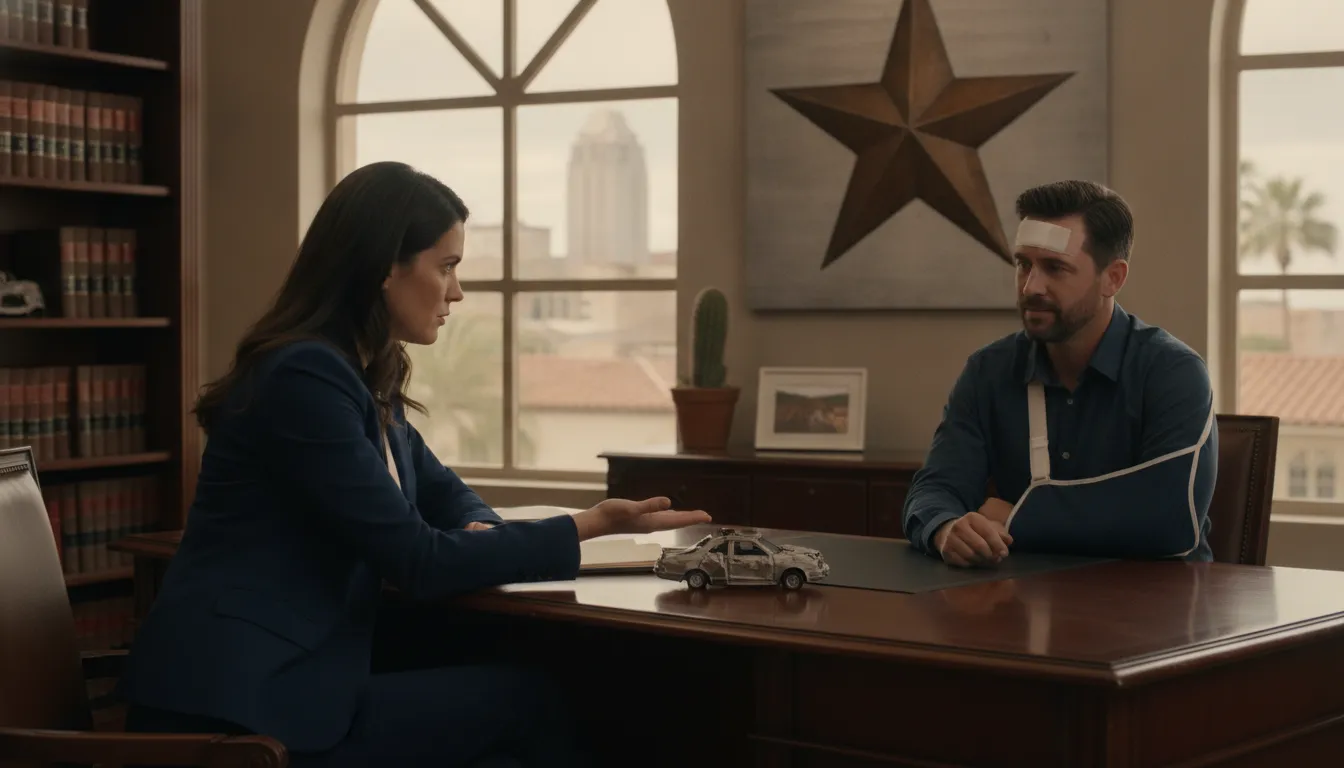
A crash with an uninsured driver can leave you dealing with medical treatment, lost income, and an insurance claim without a clear path to payment. A hit-and-run can feel even more uncertain, especially when the responsible driver cannot be identified.
An uninsured motorist accident attorney can help you pursue compensation under your own uninsured motorist coverage after an eligible Texas collision. UM coverage may apply when the at-fault driver has no insurance or cannot be found. It can cover medical bills, pain and suffering, vehicle damage, and related expenses, subject to your policy and the facts of the accident.
Call Hoch Law Firm for a free consultation to review whether uninsured motorist coverage applies to the accident and what the claim may be worth.
Texas insurers generally must offer UM and underinsured motorist coverage when you purchase auto insurance, unless you reject it in writing. The Texas Department of Insurance reports that more than 2.4 million registered vehicles are not matched to an insurance policy. So this protection can matter when the other driver cannot pay. The first step is understanding what a UM claim covers and when Texas law allows you to pursue it.
What Is an Uninsured Motorist Claim in Texas?
An uninsured motorist claim is a demand for benefits under your own automobile insurance policy after an uninsured driver causes an accident. The claim may also apply when a hit-and-run driver cannot be identified or located. Instead of relying on the at-fault driver’s ability to pay, you seek compensation from your own insurer for covered losses, including injury-related damages.
Texas requires insurance companies to offer uninsured motorist and underinsured motorist coverage when you purchase auto insurance. Under Texas Insurance Code Section 1952.101, the coverage generally applies unless you reject it in writing. The Texas Department of Insurance explains the written-rejection requirement and the protections this coverage can provide.
The need is substantial. Approximately 12% of registered vehicles in Texas, more than 2.4 million vehicles, are not matched to an insurance policy, according to the Texas Department of Insurance. If one of those drivers causes a serious crash. A UM claim may be the most practical path to recovering medical expenses, lost income, pain and suffering, and other covered losses.
Uninsured Motorist Coverage Versus Underinsured Motorist Coverage
Uninsured motorist, or UM, coverage addresses a driver who has no applicable liability insurance. Underinsured motorist, or UIM, coverage addresses a driver whose policy exists but whose limits are too low to fully compensate you for the harm caused. Texas law treats these coverages together in many policy and statutory provisions, but the available benefits depend on the facts, policy language, damages, and applicable limits.
Section 1952.105 also matters when evaluating the policy. Texas law caps UM bodily injury limits at the liability limits selected under the policy, subject to the statutory requirements. That means reviewing the declarations page and policy language is essential before assuming how much coverage is available. The other driver’s policy, your own coverage, medical records, lost-wage evidence, and the circumstances of the collision can all affect the claim’s value.
Insurers do not automatically pay the full value of a UM or UIM claim. They may question fault, the severity of an injury, treatment decisions, or the connection between the crash and later symptoms. If you need an uninsured motorist accident attorney, a careful review of the policy and evidence can help protect your rights while the insurer evaluates the claim.
When Can You Recover for an Uninsured or Hit-and-Run Accident in Texas?
You may be able to recover through uninsured motorist coverage when another driver causes your injuries but cannot provide insurance that will pay your claim. The analysis depends on what happened, whether the driver can be identified, and the coverage available under your policy. A claim can include accident-related medical bills and, when supported by the evidence, pain and suffering. Property damage and rental-car expenses may also fall within UM coverage, but injury recovery requires careful documentation and a separate evaluation of your losses.
Recovering after a hit-and-run accident
Texas UM coverage can apply when a driver leaves the scene and cannot be found to pay for the damage. The Texas Department of Insurance identifies hit-and-run crashes as a situation in which uninsured or underinsured motorist coverage may respond. See Texas Department of Insurance guidance on uninsured motorist coverage.
Prompt evidence matters in these cases. A police report, photographs, witness information, nearby surveillance, and medical records can help establish that a collision occurred and that the unknown driver caused it. You should also notify your insurer and preserve records of treatment, missed work, and continuing symptoms. The insurer may investigate whether the facts satisfy the policy’s requirements for a hit-and-run claim. That investigation does not replace the need to prove the injuries and losses caused by the crash.
When the other driver’s insurer is insolvent
A claim may also qualify when the other driver’s insurance company is insolvent and cannot pay. Texas Insurance Code Section 1952.102 defines an “uninsured motor vehicle” to include a hit-and-run vehicle and a vehicle for which the responsible insurer is insolvent or unable to make payment. The statutory definition is available through Texas Insurance Code Section 1952.102.
That classification can be important because the existence of an insurance policy does not necessarily mean there is a practical source of recovery. The claim still must satisfy the policy and legal requirements, and the available limits may restrict the total amount recoverable. An insurer may also dispute fault, causation, the seriousness of an injury, or the value of pain and suffering.
For vehicle repairs, Texas UM coverage typically carries a $250 deductible. Injury claims are different from a repair claim, and an uninsured motorist accident attorney can examine the policy, liability evidence, medical proof, and settlement position before you accept an insurer’s valuation.
How Many Texas Drivers Are Uninsured, and What Does That Mean for You?
The risk is not theoretical. More than 2.4 million Texas-registered vehicles, approximately 12% of the state’s registered vehicles, are not matched to an insurance policy, according to the Texas Department of Insurance. If one of those drivers causes a crash, there may be no liability insurer available to pay your medical expenses, lost income, or other losses.
Minimum liability coverage may not cover a serious injury
Texas Transportation Code Section 601.072 establishes minimum liability limits of $30,000 for bodily injury to one person, and $60,000 for bodily injury in one accident. It also sets $25,000 for property damage. Those limits are a legal floor, not a guarantee that an injured person will be fully compensated. A hospital stay, surgery, rehabilitation, missed work, and lasting pain can consume $30,000 quickly. When several people are injured, the per-accident limit may also be divided among their claims.
Even when the other driver carries the minimum required coverage, the available policy may be inadequate for the harm caused. And if the driver has no policy at all, pursuing that driver’s personal assets may produce little or nothing if the person cannot pay.
That is why your own uninsured motorist bodily injury coverage matters. Texas insurers must offer uninsured and underinsured motorist coverage when you purchase auto insurance, and you must reject it in writing if you do not want it. Coverage can help pay qualifying medical bills, pain and suffering, and related losses after a crash with an uninsured or underinsured driver. It can also apply when a hit-and-run driver cannot be identified.
UM coverage is not an automatic payment. You still must establish fault, prove the injury and damages, comply with policy requirements, and address the insurer’s position on the value of the claim. Reviewing the policy and preserving medical and financial evidence early can make a meaningful difference in the recovery available to you.
How an Uninsured Motorist Accident Attorney Builds Your Case
Uninsured motorist coverage is not limited to vehicle repairs. In Texas, it can pay medical bills, pain and suffering, property damage, and rental-car expenses after a qualifying crash with an uninsured driver. Uninsured Motorist Bodily Injury Coverage can also help cover injury-related medical expenses. The Texas Department of Insurance explains these coverage benefits in its guidance on uninsured motorist coverage.
Valuing the injury, not just the bills
Insurance companies often focus on amounts that are easy to document, such as emergency-room charges and repair estimates. They may undervalue pain, physical limitations, emotional distress, lost enjoyment of life, and the future effect of an injury. A careful claim valuation considers the complete medical record, the course of treatment, the prognosis, work limitations, and how the injury affects daily activities. That analysis gives the insurer a documented basis for paying the full value of the claim rather than a low initial offer.
Building evidence and testing the policy
An attorney gathers crash reports, photographs, witness information, medical records, billing records, employment evidence, and testimony about the changes caused by the injury. The attorney also reviews the policy language, coverage limits, exclusions, notice requirements, and any dispute over whether the other driver was uninsured. This matters because the insurer is evaluating its own financial exposure while also deciding whether to challenge liability, causation, or the seriousness of the injury.
| Issue | What the insurance company does | What an uninsured motorist accident attorney does |
|---|---|---|
| Injury valuation | May emphasize immediate bills and minimize non-economic damages. | Documents pain, limitations, prognosis, and the claim’s broader impact. |
| Evidence review | Looks for gaps that support disputing fault or injury severity. | Builds a consistent record from crash, medical, work, and witness evidence. |
| Negotiation | May begin with a low settlement offer. | Uses documented damages and liability evidence to pursue a fair recovery. |
| Policy interpretation | Applies its reading of coverage, conditions, and limits. | Examines the policy and challenges an interpretation that improperly narrows coverage. |
Tim Hoch is Board Certified in Personal Injury Trial Law. That experience matters when the insurer disputes the value of an injury claim. You can also learn more about working with a board-certified personal injury attorney when pursuing recovery under your UM policy.
What to Do After an Accident with an Uninsured Driver
Protect the injury claim before discussing a settlement
An accident with an uninsured or hit-and-run driver can complicate an already serious injury. The other driver has no insurance, or cannot be found, so you must work with your own policy. The steps you take immediately can preserve evidence, document your injuries, and protect a potential uninsured motorist claim.
- Seek medical care promptly. Get evaluated even if your symptoms seem manageable. Tell the provider about every symptom and how it began. Follow the recommended treatment, and keep records of visits, bills, prescriptions, missed work, and changes in your daily activities. Uninsured motorist coverage may address medical bills and other injury-related losses, but the records must connect those losses to the crash.
- Call the police and request an official report. Report the collision as soon as possible, including the other driver’s lack of insurance or the fact that the driver fled. Ask how to obtain the report and provide any identifying information, witness names, vehicle description, or direction of travel. In Texas, UM coverage may apply when a hit-and-run driver cannot be identified or found, according to the Texas Department of Insurance.
- Document the scene and your injuries. Photograph vehicle damage, the roadway, traffic controls, visible injuries, and the surrounding area when it is safe. Write down what happened while your memory is fresh. Save witness contact information, exchange details with any responding officers, and record when pain, swelling, limited movement, or other symptoms appear.
- Notify your insurer in writing. Report the collision promptly and state that you may have an uninsured motorist bodily injury claim. Keep a copy of the notice and your insurer’s responses. Do not guess about the extent of your injuries or give a recorded statement before you understand what you are signing and saying.
- Preserve evidence. Keep damaged property, photographs, medical records, employment records, repair estimates, bills, text messages, and correspondence with insurers. Do not repair or discard relevant items before photographing them and confirming that the evidence has been preserved.
- Consult an uninsured motorist accident attorney before settling. Texas UM coverage can pay for medical bills, pain and suffering, property damage, and rental-car expenses, as explained by the Texas Department of Insurance. A settlement release may end your ability to seek additional compensation. Have an attorney review the policy, evidence, and insurer’s offer before you accept any payment.
Call Hoch Law Firm for a free consultation
Have your uninsured motorist claim and the insurer’s offer reviewed by an attorney before you make any decision.
Frequently Asked Questions
What is uninsured motorist coverage?
Uninsured motorist coverage is protection under your own auto policy when an at-fault driver has no insurance. In Texas, insurers must offer uninsured and underinsured motorist coverage when you purchase auto insurance, and you must reject it in writing to decline it. The coverage can address injury-related losses and certain property damage. Texas Department of Insurance
Does uninsured motorist coverage pay for medical bills?
It can. Texas UM coverage may pay medical bills, pain and suffering, property damage, and rental-car expenses after a qualifying collision with an uninsured driver. The available recovery depends on your policy, the evidence of fault, and the nature and extent of your losses. (Source: Texas Department of Insurance.)
Can I recover UM benefits after a hit-and-run accident?
Yes, Texas UM coverage can apply when a hit-and-run driver cannot be found to pay for the damage. Report the collision promptly, seek medical care for injuries, preserve photographs and witness information, and notify your insurer. Your policy and the facts of the crash determine what proof is required. (Source: Texas Department of Insurance.)
What is the difference between UM and UIM coverage?
UM coverage addresses an at-fault driver who has no insurance. Underinsured motorist coverage addresses a driver whose liability limits are not enough to cover your losses. Both may provide a claim against your own policy, but coverage limits, exclusions, notice requirements, and available damages must be reviewed carefully.
Do I need an attorney for an uninsured motorist accident in Texas?
You are not required to hire an attorney, but legal guidance can help when fault, medical causation, policy coverage, or the value of pain and suffering is disputed. An attorney can analyze the policy, develop the evidence, and challenge an insurer’s attempt to undervalue the claim. Do not assume an initial offer reflects the full value of your losses.
Ready to Discuss Your Uninsured Motorist Claim?
After an uninsured or hit-and-run crash, a careful review of your coverage and injury documentation can help clarify the recovery available under your policy. Hoch Law Firm can explain your options and the next steps without promising a particular result.