Building insurance for commercial property is the part of a Texas policy that pays to repair or replace the structure after a covered loss. It is not the same thing as contents, lost rent, or the cost of keeping the business open. Owners of offices, retail centers, warehouses, and apartments in Dallas-Fort Worth usually find those parts on the declarations page. A reservation letter can leave one of those parts open while the carrier keeps investigating.
Call Hoch Law Firm at (817) 731-9703
Hoch Law Firm represents Texas policyholders, not insurance companies, in commercial property coverage disputes. Tim Hoch is Board Certified in Personal Injury Trial Law by the Texas Board of Legal Specialization. He handles a select few cases at a time on a contingent fee basis. The commercial property insurance page lists offices, retail centers, warehouses, manufacturing sites, and apartments, and losses from fire, hail, wind, rain, tornado, flood, surge, and vandalism. Start there, and on the insurance page, then use this guide to sort the building from the rest of the policy. The contact page is where to send the declarations page and the letter.
What Building Insurance for Commercial Property Covers
Most commercial forms split the risk into named coverages. The building part pays for the structure the insured owns or is required to insure. Business personal property pays for contents. Business income and extra expense pay for the time the building cannot be used as it was. Loss of rents pays a landlord when a unit cannot be occupied. Those are different promises, even when one carrier writes them on one policy.
The declarations page is the first place to look. It should name the premises, the limits, the deductible, and whether the building is valued at replacement cost or actual cash value. Our note on what a Texas commercial property insurance declarations page shows walks through that sheet. The form language behind it decides what “building” includes: walls, roof, floors, permanently installed fixtures, and sometimes glass, signs, or fencing. A freestanding cooler or a tenant’s furniture is often outside that definition.
Replacement cost and actual cash value are valuation methods, not extra coverages. Replacement cost aims at the cost to repair with materials of like kind and quality, without a deduction for age. Actual cash value starts from that cost and subtracts depreciation. Many policies pay actual cash value first and hold the rest until repairs are finished. That holdback is a valuation rule. It is not, by itself, a decision that the building is uncovered.
A commercial property insurance deductible comes off the building loss before the limit applies. Wind and hail deductibles are often a percentage of the building limit, not a flat dollar amount. Read that percentage against the building limit on the declarations page before you compare two estimates.
How Building Coverage Differs From the Rest of the Policy
Owners mix these parts up because a storm hits all of them at once. The roof is a building item. The soaked inventory is usually business personal property. Payroll and lost sales during the repair are business income, if that coverage was purchased and the loss is covered. Temporary rent for a replacement suite is often extra expense. A landlord’s lost rent on a damaged suite is a separate coverage, and it follows the lease and the period of restoration, not the contractor’s invoice.
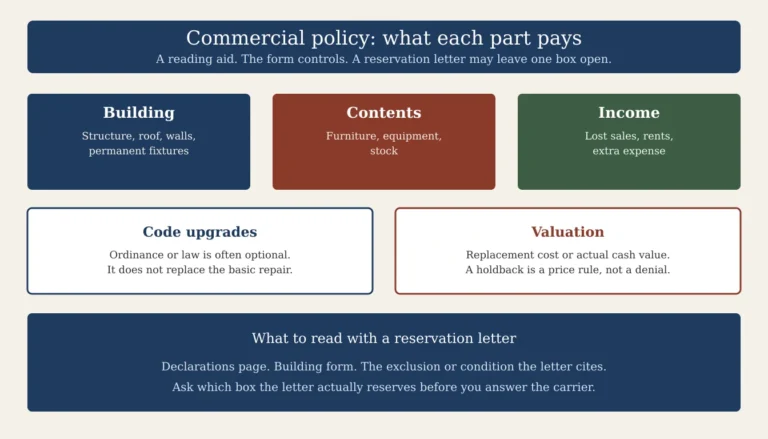
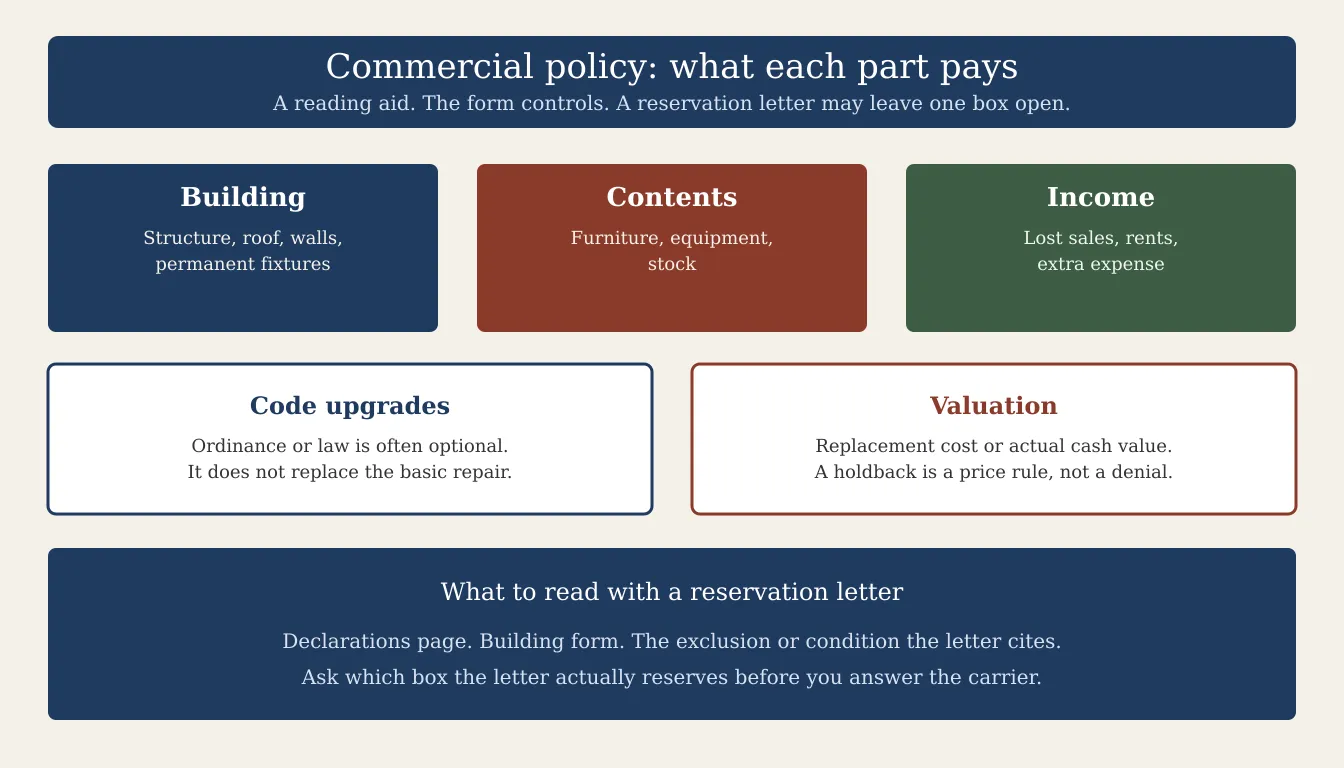
The diagram below is a reading aid for those boxes. Your form controls. Do not treat a box as a promise that your policy includes that part. A reservation letter may leave one box open while the others stay in play.

The table below uses the same split. It is a reading aid, not a coverage grant.
| Policy part | What it is aimed at | What it does not replace |
|---|---|---|
| Building | Repair or replacement of the structure, including permanently installed fixtures described in the form. | Tenant contents, lost sales, or a code upgrade you did not buy. |
| Business personal property | Furniture, equipment, stock, and other contents the form schedules or describes. | The roof, walls, or foundation. |
| Business income | Income the business would have earned during the period of restoration after a covered loss. | The cost of the physical repair itself. |
| Extra expense | Necessary extra cost to continue operating, such as a temporary location. | Ordinary rent you would have paid anyway. |
| Loss of rents | Rental income lost when a covered loss makes a unit untenantable. | A vacancy that started before the loss, or a tenant who left for another reason. |
| Ordinance or law | Demolition, increased cost of construction, or the undamaged portion when a code forces more work. | The basic repair that would have been required without the code. |
Business interruption has its own proof: financials, the period of restoration, and the cause of the shutdown. The business interruption claims page covers that claim. Extra expense disputes belong on the extra expense coverage claim dispute guide. Landlords with a rent loss can start at loss of rent insurance claims. This article stays on the building.
What a Reservation Letter Can Leave Open on the Building
A reservation-of-rights letter is the carrier’s notice that it may later deny part of the claim. The letter process itself, including how it differs from a denial, is already covered in our reservation letter review. What matters here is which building part the letter actually reserves.
Read the cited exclusions and conditions against the building form, not against the whole policy in the abstract. A wear-and-tear or faulty-workmanship citation may be aimed at the roof. A flood or water exclusion may be aimed at the ground floor. A vacancy condition may be aimed at a suite that was empty before the storm. Those are different fights. A letter that quotes one of them has not, by that quote alone, reserved business income or the tenant’s contents.
These are the building limits that show up most often in these letters.
- A named exclusion, such as flood, earth movement, or wear and tear, applied to the damaged portion of the structure.
- A coinsurance or insurance-to-value condition. The formula and the penalty math live on our coinsurance page for Texas commercial property. Do not redo that math from the letter alone.
- An ordinance or law gap. Code-driven demolition and the increased cost of construction are often optional. The breakdown is on the ordinance or law coverage guide.
- A valuation dispute: replacement cost versus actual cash value, or a depreciation holdback. That is a price fight on a covered repair, not a coverage denial, unless the letter says otherwise.
The exclusions catalog is a separate subject. If the letter names an exclusion and you need the wider list, use common commercial property insurance exclusions Texas businesses see. Bring the letter, the declarations page, and the building form to that reading. Do not answer the carrier’s coverage questions from memory.
Limits, Causes of Loss, and Who Insures the Structure
Commercial building forms are usually written on a cause-of-loss basis. A special or all-risk form covers direct physical loss unless an exclusion applies. A named-peril form covers only the causes it lists, such as fire, wind, or hail. The same broken window can be covered under one form and not the other. The declarations page should say which causes-of-loss form is attached to the building.
A sublimit is a cap inside the building limit. Glass, outdoor signs, fences, debris removal, and pollutant cleanup often sit on a sublimit far below the building limit. An estimate that prices the whole building limit will overstate what the form pays for that item. Ask for the sublimit endorsement before you accept a line item that looks fully covered.
Who must insure the structure is a lease question as much as a policy question. A triple-net lease may require the tenant to carry the building. A gross lease may leave the structure with the owner. The policy’s named insured and the mortgagee or loss payee control who can collect and who must sign the proof of loss. A tenant’s contents policy does not repair the landlord’s roof. A landlord’s building policy does not replace the tenant’s fixtures unless the form says so.
Hoch Law Firm’s commercial property work includes offices, retail centers, warehouses, industrial buildings, manufacturing sites, and apartments across Texas, with the office in Fort Worth. Tim Hoch is licensed in Texas and Oklahoma and has practiced in Fort Worth since 1988. The right reader of a building claim is the person who owns or is required to insure that structure, not every tenant who lost a day’s sales.
Building Insurance for Commercial Property After a Texas Loss
After a loss, separate the file into building proof and everything else. Building proof is the scope a contractor or estimator ties to the structure: roof, walls, windows, doors, and permanent fixtures. Photographs, moisture readings, and the cause-of-loss notes belong with that scope. Invoices for inventory, payroll, and temporary rent belong in the other files so a building payment is not reduced by a fight about income.
Texas also sets claim-handling deadlines for many property carriers. Under Texas Insurance Code section 542.055, an insurer generally must acknowledge a claim, start any investigation, and request added items not later than the 15th business day after notice. Under section 542.056, it generally must accept or reject the claim not later than the 15th business day after it receives the items it required. Under section 542.057, once it says it will pay, it generally must pay within five business days. Under section 542.058, except as otherwise provided, delay past 60 days can trigger the damages that section states. The clock runs after the insurer receives the items, statements, and forms reasonably requested under section 542.055, unless another statute sets a different period.
Deadlines can differ by line of insurance. A weather-related catastrophe can extend the acceptance window. The text is on the Texas Insurance Code, Chapter 542. A reservation letter does not erase those duties. It also does not decide the building limit.
While the letter is open, keep the building file current. Send the items the carrier asked for that you actually have. Mark the date you sent them. Do not agree that an uncovered cause, such as long-term wear, is the only reason the roof failed if the storm evidence says otherwise. Do not treat a partial building payment as a final word on code upgrades or on the depreciation holdback.
Call (817) 731-9703 to review the building portion of your policy
Frequently Asked Questions
What does building insurance for commercial property usually pay for?
It usually pays to repair or replace the structure after a covered cause of loss, up to the building limit, minus the deductible and any sublimit. Contents, lost income, extra expense, and lost rent are separate parts unless your form folds them in.
Does a reservation-of-rights letter mean the building is not covered?
No. The letter says the carrier is still investigating and may later deny some or all of the claim. You still have to read which exclusion, condition, or valuation issue it cites, and whether that citation reaches the building or only another part of the policy.
How is replacement cost different from actual cash value on a building?
Replacement cost looks at the cost to repair or replace with materials of like kind and quality, without subtracting age. Actual cash value subtracts depreciation. Many policies pay actual cash value until the repair is done, then release the rest if the form’s conditions are met.
Who should be the named insured on a commercial building policy?
The owner, or the tenant the lease requires to insure the structure, should be a named insured or otherwise scheduled. A mortgage lender is often a mortgagee or loss payee. A contents-only tenant policy does not take the place of building coverage.
When should an owner call a lawyer about the building claim?
Call when a reservation letter cites an exclusion or a coinsurance penalty on the structure. Also call when the offer uses actual cash value and the form says replacement cost, or when code upgrades are left off the estimate. Use the contact page to send the letter and the declarations page for a case review.
Bring the declarations page, the building form, the reservation letter, and the repair scope. We will tell you whether the dispute is about the structure, about another coverage, or about price. Tim Hoch reviews the cases the firm accepts and works them directly.