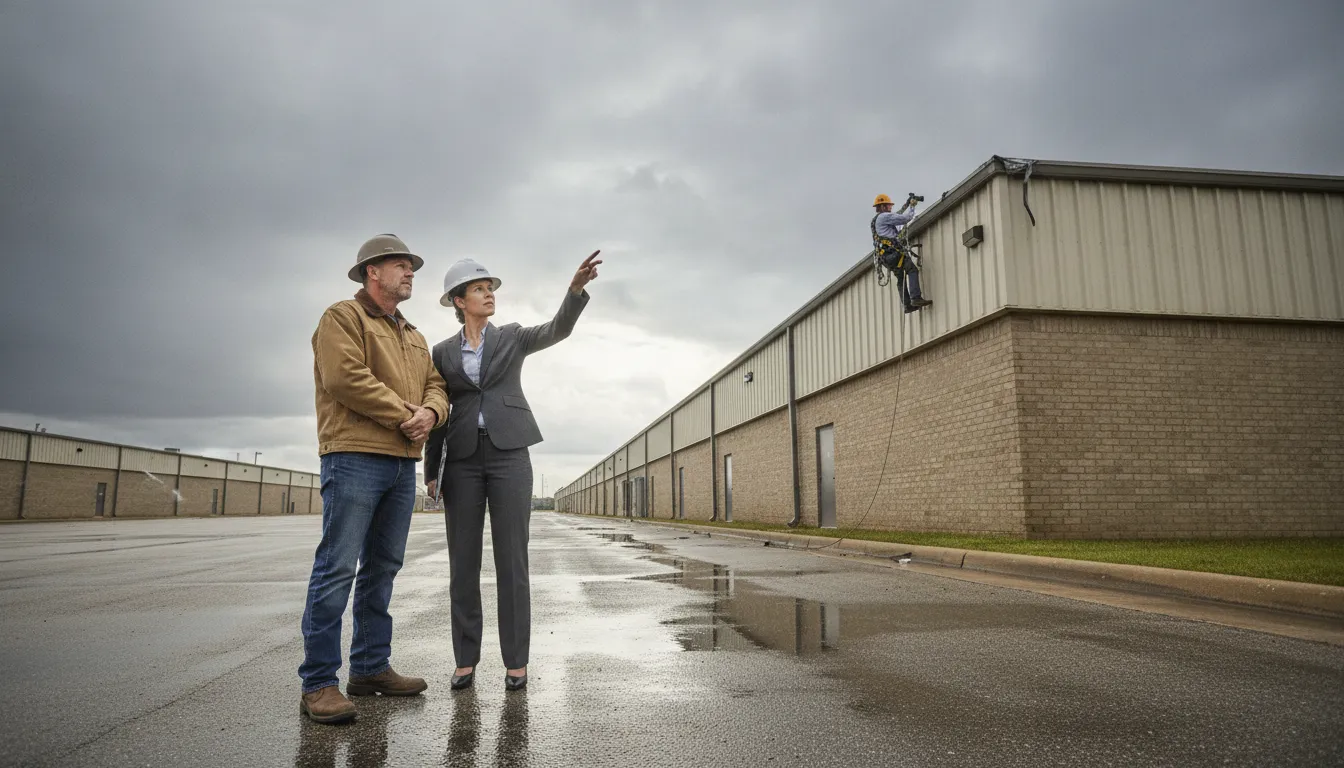
A leaking commercial roof can affect far more than the roof itself. Water intrusion may damage inventory, equipment, tenant space, and business operations, while rushed repairs can make it harder to show what happened and when.
Strong commercial roof damage claim documentation for Texas property owners should connect the event to the physical damage and financial loss. Preserve dated photos and video, safe inspection records, contractor or engineer findings, maintenance records, repair invoices, communications, and a clear damage timeline. Then compare those records with the actual policy, including applicable endorsements and duties after a loss.
Call Hoch Law Firm at 817-731-9703 about your commercial roof claim.
The best record is organized before memories fade and documents scatter across contractors, property managers, tenants, and insurers. Start by building a practical evidence file that gives the adjuster, your team, and any later reviewer a reliable view of the loss.
What should commercial roof damage claim documentation for Texas property owners include?
Commercial roof damage claim documentation for Texas property owners should make the loss understandable from the first storm report through the repair estimate. Build one organized claim file rather than relying on scattered emails, phone notes, or a contractor’s memory. The file should show what was damaged, when it was observed, and what expenses or communications followed.
Start with a damaged-property inventory. List each affected roof area, building system, piece of equipment, or inventory category, along with a short description of the observed condition. The Insurance Information Institute explains that an inventory of damaged or destroyed items can help substantiate a business insurance loss. Its business-claim guidance also identifies photos and video as useful ways to document property damage.
Evidence checklist for the claim file
| Evidence | What to record |
|---|---|
| Damage inventory | Building or roof area, affected component, visible condition, and related property or equipment. |
| Photos and video | Clear views of the damage and the surrounding context, organized by building, area, and date. |
| Claim administration | Claim reference number, adjuster and insurer contact information, and a dated log of communications. |
| Repair documentation | Contractor or engineer findings, estimates, repair bills, and receipts connected to the affected property. |
Keep original files where possible, preserve the date and location context, and save copies of everything sent to or received from the insurer. The III recommends retaining the claim reference number, adjuster contact information, photographs, receipts, repair bills, and estimates in the claim file. Its business-claim guidance provides that recordkeeping framework.
Documentation does not replace the policy or establish coverage by itself. It gives the insurer and the property owner a clearer factual record for evaluating the loss. If the dispute involves broader legal issues, Hoch’s Texas roof damage insurance claim resource provides related context.
What should you do first after commercial roof damage in Texas?
The first response should protect people, preserve the property, and create a clear record. Move promptly, but let the policy and site conditions control what happens next. Do not send employees onto an unstable roof or begin permanent repairs before documenting the damage.
- Make the property safe before inspecting it. Keep employees, tenants, vendors, and visitors away from areas with possible structural damage, falling materials, exposed wiring, standing water, or other hazards. Do not access an unsafe roof. A visual observation from a safe location can establish the immediate condition, while a qualified professional evaluates areas that cannot be safely reached.
- Notify the insurer or insurance professional promptly. The Insurance Information Institute advises contacting the insurer or insurance professional as soon as possible after a commercial property loss. Identify the property, apparent event date, and visible damage. Record when notice was made, who received it, and any claim reference number. The III explains the business claim process.
- Read the policy’s post-loss duties. A commercial property policy may specify steps the insured must take after a loss. Review the applicable policy, endorsements, notice provisions, inspection requirements, and instructions for proof or documentation. Avoid assuming that a general checklist replaces the duties stated in the policy that covers the building.
- Take reasonable protective measures only when safe. If conditions permit, use temporary measures to reduce additional damage, such as protecting exposed areas from continuing water intrusion. Do not destroy or conceal evidence. Photograph the condition before and during the work, and retain each receipt, invoice, and work description. The III advises taking protective steps only when safe and saving receipts for possible reimbursement. See the III’s mitigation guidance.
- Preserve the scene and begin a contemporaneous log. Before debris is moved or materials are discarded, note what changed, when it changed, and who performed the work. Save communications with the insurer, adjuster, property manager, contractor, tenants, and emergency vendors. A dated timeline helps connect the storm or other event to the observed damage, temporary measures, inspections, and claim communications without overstating what the evidence proves.
How do you create a reliable visual record of roof damage?
Start with a consistent record that lets a reviewer understand what was damaged, where it was located, and how conditions changed after the event. Before an adjuster inspection, identify building damage and prepare a list of the areas and items you want to show. The Insurance Information Institute recommends making that list as part of preparing for the inspection.
Use dated photographs and video from safe vantage points. Capture wide views that establish the building area, followed by closer images of punctures, displaced materials, water entry, interior staining, damaged equipment, and other affected systems. Photograph more than the most dramatic spot. Label each file with the date, building or suite, roof section, and a short description. Do not climb onto a roof or enter an unsafe area to obtain an image. A ground-level view, drone record from a qualified professional, or contractor documentation may be safer.
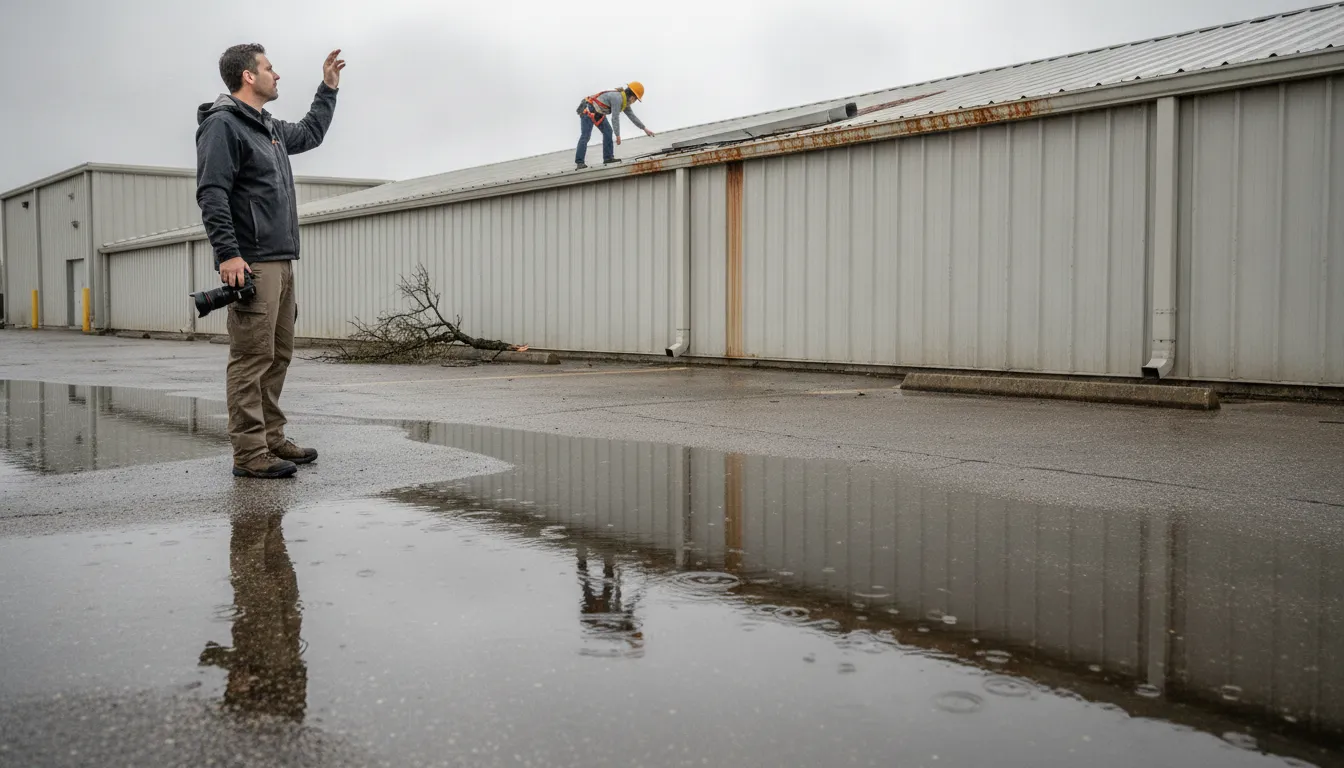
Build a pre-loss and post-loss comparison when records are available. Prior inspection reports, maintenance photographs, leases, work orders, and contractor or engineer findings may help show the property’s condition before the storm. Place those materials beside current images rather than relying on memory. The comparison does not decide coverage by itself, but it gives the claim file a clearer factual timeline.
Keep a written damage timeline. Note when the storm or suspected loss occurred and when damage was discovered. Record when temporary measures were taken, who inspected the property, and when the insurer or adjuster was contacted. Add the locations of leaks, closures, equipment damage, and visible changes. A dated sequence can help connect observations to the reported event without overstating what the evidence proves.
Preserve damaged materials and debris until the insurer has had a reasonable opportunity to inspect them when practical. The Insurance Information Institute advises photographing damage, including destroyed items, and asking the insurer before removing debris. If disposal is necessary first, notify the insurer and photograph or video the items before discarding them. Save the original files and back them up with the claim correspondence.
For commercial roof damage claim documentation for Texas property owners, the goal is an organized factual record, not a conclusion about coverage. The policy language, condition evidence, and claim investigation still control.
Which policy and property records strengthen a commercial roof claim?
Policy documents establish the framework for evaluating a commercial roof loss. Start with the declarations page. It identifies the named insured, property address, policy number, categories of coverage, dollar limits, and endorsements. Preserve the declarations page that applied when the damage occurred, not only a renewal or summary downloaded later.
Confirm that you have the complete, current policy, including all forms and endorsements. Endorsements can modify how coverage applies, what exclusions or conditions matter, and which records the insurer may request. The Insurance Information Institute recommends reviewing the applicable endorsements rather than relying on a general understanding of the policy. Read the guidance on organizing business insurance records as a starting point, then compare those documents with the policy for the loss date.
Connect the policy to the property record
Keep maintenance and inspection records in the same claim file. Useful examples include roof service agreements, inspection reports, photographs taken before the storm, work orders, invoices, repair recommendations, and communications with contractors or property managers. These records can help distinguish the roof’s pre-loss condition from the condition observed after a storm. They do not decide coverage by themselves, but they give the insurer and property owner a clearer factual record.
For leased buildings or professionally managed properties, preserve relevant leases, management agreements, tenant notices, inspection logs, and communications about access, leaks, or prior repairs. The right records depend on the ownership and operating structure. They may also help identify who observed the condition, who authorized work, and how the damage affected the property.
Document value without turning this into a valuation formula
Business records can help establish the value of damaged equipment, inventory, or structures. Gather records that identify the affected building systems and property, while keeping repair estimates and invoices in a separate expense folder. Avoid assuming that a maintenance history proves wear and tear, or that a pre-loss photograph proves a covered cause. Policy language, causation evidence, and the complete claim record still control.
If policy interpretation or the insurer’s position becomes disputed, a commercial property insurance dispute review can help organize the relevant records without duplicating a separate coinsurance analysis.
How should you organize estimates, invoices, and repair expenses?
Organize the financial record as carefully as the damage record. Start with a claim log showing the date of each call, email, inspection, estimate, invoice, payment, and submission. Record the names and phone numbers of the adjuster, contractor, engineer, mitigation company, and other people involved. The Insurance Information Institute recommends keeping copies of documents submitted to the insurer and paperwork received in return. Its guidance also identifies receipts, repair bills, and estimates as useful parts of the claim file: business insurance claim documentation guidance.
Use a consistent file name for each document, such as the property address, vendor, date, and expense category. Keep the original estimate, any revised scope, photographs supporting the work, the final invoice, and proof of payment together. Separate emergency mitigation from permanent repairs, and note why each expense was necessary. If the insurer or adjuster requests a proof-of-loss form or repair estimate, save the request and your complete response in the same file.
For mitigation work, retain itemized invoices, receipts, contracts, work orders, delivery records, and payment confirmations. Credit-card statements, canceled checks, and bank records can help connect a payment to a specific repair, but they should supplement, not replace, an itemized invoice. Do not assume an expense is covered simply because it was reasonable. The policy, endorsements, causation evidence, and the facts of the loss still control.
Some Texas property owners may also need endorsement-specific proof. For example, the cited Texas Windstorm Insurance Association replacement-cost endorsement requires an accurate record of repair expenses and proof of payment of an applicable deductible. It lists invoices, bills, statements, receipts, canceled checks, money-order receipts, and credit-card statements as examples. It also states that replacement-cost payment may remain limited to actual cash value until repair or replacement is completed and the required documentation is submitted. Review the exact endorsement and the Texas Department of Insurance PDF containing that TWIA endorsement language; these requirements are not universal to every Texas policy.
Finally, track depreciation separately from the repair total and payments received. A scope or payment disagreement may involve how depreciation was calculated, not just whether work was completed. See Hoch’s guide to commercial property claim depreciation disputes for that narrower issue.
How do you document business interruption, rents, and extra expenses?
Roof damage can create losses beyond the cost of replacing materials. Build a separate business-loss file showing what the property or business generated before the interruption, what it generated afterward, and how the change relates to the covered event. A business-income claim may require proof of income from both periods, so preserve the underlying records rather than relying on a summary estimate. Business interruption claim documentation should be organized alongside the property-damage file, not reconstructed months later.
Start with records that show the normal financial picture and the interruption period. Depending on the business, that may include tax returns, monthly sales-tax returns, contracts, budgets, and financial statements. These are examples of records that can support an income calculation, as described by the Insurance Information Institute. Preserve versions from before and after the loss, identify the relevant dates, and explain unusual changes rather than deleting them from the record.
For an income-producing property, keep rent rolls, leases, tenant notices, payment histories, vacancy records, and correspondence about access or delayed occupancy. Tie each claimed reduction to a specific unit, tenant, or period. This creates a clearer record of proof of rental income losses while helping separate lost rent from unrelated vacancy or collection issues.
Track extra expenses in a dedicated ledger. Include the date, reason, vendor, property or business location, amount, and supporting invoice or receipt. Depending on the policy and facts, potentially relevant categories may include additional operating expenses, payroll during closure, utility interruption, and contingent business interruption. Contingent losses may involve disruption affecting a supplier, tenant, or other connected operation, so preserve the contract and communications that explain the relationship. Coverage depends on the policy language and claim facts. Keep payroll reports, utility bills, temporary operating costs, and mitigation-related records together so the financial effect can be tested rather than estimated from memory.
How do Texas claim deadlines affect roof-damage documentation?
How long do you have to file a roof-damage claim? There is no single answer for every Texas commercial property owner. Notice, proof-of-loss, claim-filing, and lawsuit deadlines can come from the policy, an endorsement, the applicable policy form, and Texas law. Review the actual policy and applicable form before relying on any date.
Some Texas windstorm and hail policy forms for designated catastrophe areas may include a contractual suit limitation. Under the cited Texas statute, the period may not end before the earlier of two years after the insurer accepts or rejects the claim. Or three years after the date of loss. Certain covered forms may also require filing a claim no later than one year after the loss, subject to statutory conditions and a good-cause exception. These provisions are form-specific, not universal deadlines for every roof claim. Read the applicable Texas Insurance Code provision and compare it with the policy issued for the property.
Documentation should begin as soon as possible, even while the coverage and deadline analysis is still developing. Report the loss promptly, then preserve the materials that establish when damage occurred and how it progressed. Keep dated photographs and video, safe inspection records, contractor or engineer findings, maintenance records, repair estimates, invoices, and a written timeline of notices and communications. The policy may also require a proof of loss or other information within a specified period after the insurer requests it. A missed documentation task can create a separate problem from the underlying roof damage.
Texas claim-handling rules also address insurer communications. The statute generally sets a response period after notice of a claim and addresses written acceptance or rejection after the insurer receives required final-proof-of-loss items, statements, and forms. If more time is needed, the insurer must provide the reasons during the applicable period. Defined weather-related catastrophes or major natural disasters can extend specified claim-handling deadlines by 15 days. That extension concerns insurer handling, not permission for an owner to delay notice or ignore a policy deadline.
For a significant loss, organize a deadline calendar with the loss date, notice date, proof-of-loss requests, insurer correspondence, and any stated filing or suit date. Have counsel review the policy before a deadline becomes an emergency.
Call Hoch Law Firm at 817-731-9703.
When should a Texas property owner seek legal help with a roof claim?
Consider a policy review when the claim record starts producing a material disagreement, not simply because an insurer asks ordinary questions. A denial or a payment materially below the documented scope can justify a closer look at the policy and evidence. So can a dispute over whether wind, hail, rain, wear, or another cause produced the damage.
Scope disputes are another warning sign. For example, the insurer may recognize some roof damage but omit related building components. Separate damage into categories, or rely on an interpretation that does not match the policy language and physical findings. Repeated requests for the same documents can also make it harder to tell what remains outstanding. Keep a dated record of submissions, responses, adjuster contacts, estimates, and the specific items under review.
An insurer may request a signed, sworn proof of loss containing information needed to investigate the claim. The Insurance Information Institute describes this as part of the claim process, but signing a sworn submission deserves care. Compare it with your records, identify unresolved issues, and consider legal review before certifying facts you cannot support. Do not discard damaged materials or alter evidence because someone suggests the claim will move faster. Preserve photographs, inspection findings, repair records, and communications while taking safe steps to protect the property.
Texas claim-handling law addresses written notice of acceptance or rejection after the insurer receives required final-proof-of-loss items, statements, and forms. It also allows an insurer that needs more time to explain the reasons for the delay during the applicable decision period. Those rules do not decide whether a particular roof loss is covered. The policy, the documented condition of the property, the cause of damage, and the claim correspondence still matter. Review the actual record rather than assuming every delay or disagreement is bad faith.
Hoch Law Firm represents commercial property owners in coverage disputes, denied or underpaid claims, storm damage, and business interruption matters. A lawyer can assess whether the documentation supports the claimed scope and whether the insurer’s position is consistent with the policy. For general legal options involving a Texas roof damage insurance claim, see the related guide. Owners facing a broader commercial property insurance dispute can also review the firm’s dispute-focused resource.
Frequently Asked Questions
How long do I have to report commercial roof damage in Texas?
There is no single deadline for every commercial property policy. Report the loss promptly, then review the policy, endorsements, and any claim-filing or suit-limitation provisions that apply to the property. Certain Texas windstorm and hail forms may include a one-year claim-filing period or specific contractual limitations, subject to statutory conditions. See Texas Insurance Code Section 2301.010.
What should I preserve before repairs or debris removal?
Preserve dated photos and video from safe locations, inspection findings, damaged materials, maintenance records, communications, and a timeline of events. If debris or damaged items must be removed before inspection, notify the insurer and photograph or video the condition first. Keep temporary-repair receipts and do not enter an unsafe area.
What records help document business interruption or lost rents?
Separate the physical roof damage file from the financial-loss file. Gather income records from before and after the interruption, along with relevant tax returns. Sales-tax returns, contracts, budgets, financial statements, rent records, payroll information, and receipts for extra expenses. The policy controls which losses may be covered.
When should a commercial property owner seek legal review?
Consider a policy and claim-file review when the insurer disputes the cause or scope of damage. Requests a sworn proof of loss, underpays or denies the claim, or questions business-income or rental losses. A lawyer can assess the policy language and the evidence together without assuming that every disputed claim involves bad faith.
Ready to discuss your commercial roof damage claim?
A well-organized documentation record can make it easier to explain what happened, identify the losses at issue, and evaluate how the policy may apply. If your Texas commercial property has roof damage or related claim losses, Hoch Law Firm can review the situation and discuss practical next steps.