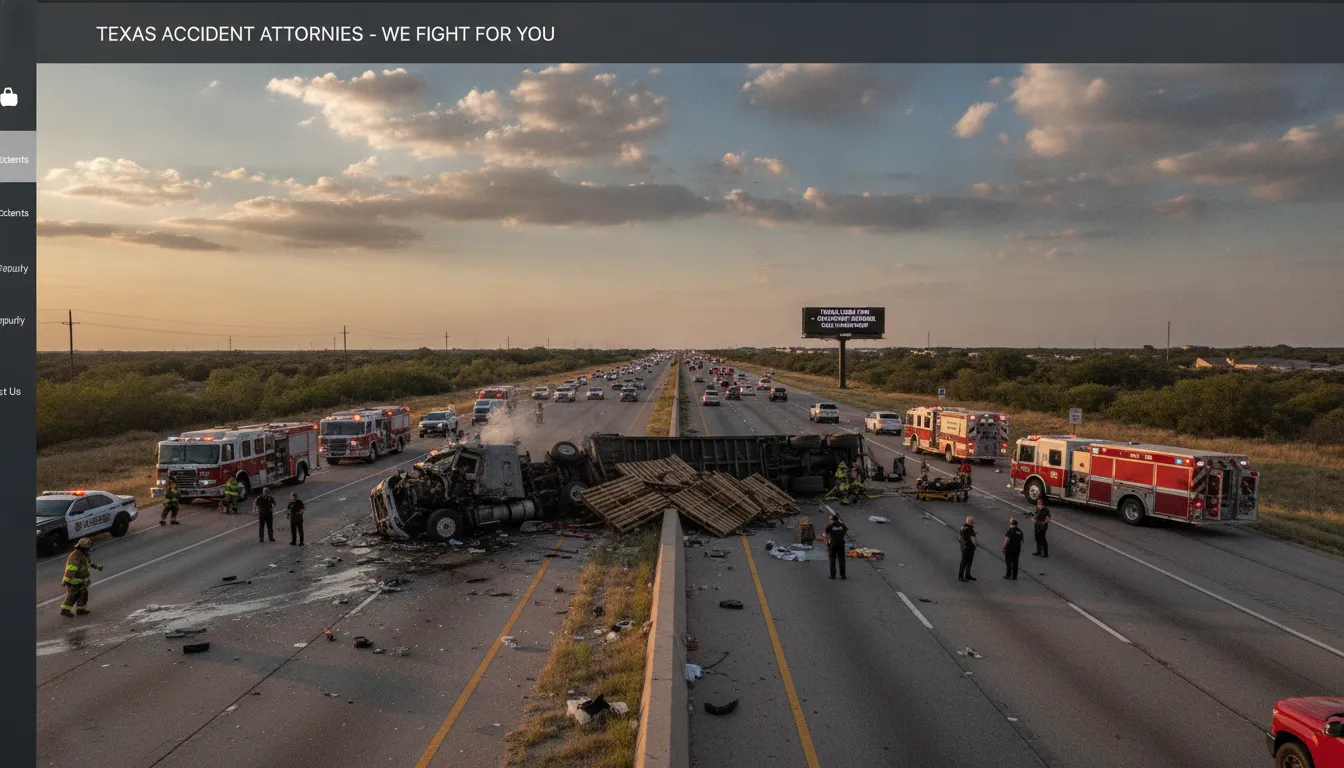
When an 18-wheeler collides with a passenger vehicle, the results are catastrophic. A fully loaded semi truck can weigh up to 80,000 pounds, which is roughly twenty times the weight of the average car. In Texas, which leads the nation in truck crash fatalities, these accidents happen with alarming frequency on highways from I-35 to I-10 and every major corridor in between. Knowing what to do immediately after an 18-wheeler accident in Texas can mean the difference between protecting your legal rights and losing critical evidence that could support your claim.
This guide walks you through the exact steps you need to take, from securing medical care at the scene to preserving evidence and understanding the legal process. If you or a loved one has been injured in a truck accident, acting quickly is essential to building the strongest possible case.
18 Wheeler Accident Texas: Immediate Steps to Take After an 18-Wheeler Accident in Texas
The moments immediately following a collision with a commercial truck are overwhelming. But the actions you take have a direct impact on both your health and any future legal claim. Follow these steps in order:
- Check for injuries and call 911. Your health comes first. Even if you feel fine, adrenaline can mask serious injuries like internal bleeding, whiplash, or traumatic brain injury. Request emergency medical services and a law enforcement response.
- Move to a safe location if possible. If your vehicle is drivable and you are not seriously injured, pull to the shoulder or a nearby parking lot. Stay away from traffic. If you cannot move the vehicle, remain inside with your seatbelt fastened and wait for help.
- Do not admit fault or apologize. Anything you say at the scene can and will be used by the trucking company’s insurance adjusters. Even a casual “I’m sorry” or “I didn’t see them” can be twisted into an admission of liability. Stick to the facts with law enforcement and decline to give a recorded statement to any insurance representative at the scene.
- Exchange information with the truck driver. Obtain the driver’s full name, commercial driver’s license number, and contact information. Also collect the trucking company name, the USDOT number (displayed on the side of the truck). The tractor and trailer license plate numbers, and the insurance company name and policy number.
- Gather contact information from witnesses. Independent witnesses who saw the crash are invaluable. Ask for their names and phone numbers. If they are willing, ask what they saw while it is fresh in their memory.
- Request a copy of the police report. When law enforcement arrives, ask how to obtain the official crash report. In Texas, these reports are typically available within 7 to 10 days through the responding agency. The report will include the officer’s assessment of fault, citations issued, and critical details about the scene.
Preserving Critical Evidence After a Texas 18-Wheeler Accident
Evidence begins to disappear within hours of a crash. The trucking company and its insurance carrier will dispatch their own investigators to the scene, often before you have left the hospital. Preserving evidence is one of the most important things you can do to protect your claim in an 18-wheeler accident in Texas.
Photographs and Video
Take as many photographs as your condition allows. Capture the position of both vehicles, damage to all parties, skid marks, debris fields, road conditions, weather conditions, traffic signs and signals, and any visible injuries. If your vehicle has a dashcam, preserve that footage immediately. Also ask nearby businesses or homes if their security cameras may have captured the crash.
The Truck’s Black Box and ELD Data
Commercial trucks are equipped with event data recorders (EDRs), often called black boxes, that capture speed, braking, steering input, and engine data in the moments before a crash. The truck also has an electronic logging device (ELD) that records the driver’s hours behind the wheel. This data is critical for determining whether driver fatigue played a role. Your attorney can issue a spoliation letter demanding that the trucking company preserve all electronic data without alteration.
Driver Logbooks and Maintenance Records
Federal law requires trucking companies to maintain detailed records of driver hours, vehicle inspections, and repairs. Repair logs as evidence can reveal whether the trucking company neglected mandatory maintenance, such as brake inspections or tire replacements, that may have contributed to the crash.
Medical Records
Seek medical evaluation immediately, even if you believe your injuries are minor. Some of the most serious injuries resulting from an 18-wheeler accident in Texas, including internal bleeding. Spinal cord damage, and traumatic brain injury, may not present symptoms for hours or days. A thorough medical record establishes the connection between the crash and your injuries.
Common Causes of 18-Wheeler Accidents on Texas Highways
Understanding what caused the crash helps establish liability. Most truck accidents fall into one or more of these categories. Texas highways present unique challenges, from high-speed rural interstates to congested urban corridors in Dallas, Houston, San Antonio, and Austin.
Driver Fatigue
Driver fatigue is the leading cause of commercial truck accidents nationwide. Despite federal hours-of-service limits, the pressure to meet delivery deadlines pushes many drivers to skip rest breaks or falsify logbooks. In one recent DFW-area case covered by FOX 4, a truck driver admitted to police that he fell asleep at the wheel. Causing a crash that killed four family members and another driver. Fatigue impairs reaction time as severely as alcohol intoxication.
Distracted Driving
Truck drivers face enormous pressure to stay connected with dispatchers, navigate unfamiliar routes, and manage in-cab technology. Texting, eating, adjusting navigation, or using a handheld device while operating an 80,000-pound vehicle creates a catastrophic risk.
Improper Maintenance
Brake failure is one of the most common mechanical causes of truck accidents. Federal data shows that brake-related violations are consistently among the most frequent out-of-service violations found during roadside inspections. Tire blowouts, steering system failures, and lighting defects also contribute to preventable crashes.
Speeding and Aggressive Driving
Empty or partially loaded trucks require significantly different stopping distances than fully loaded ones. Speeding reduces the driver’s ability to react to sudden changes in traffic and dramatically increases stopping distance, especially on wet or poorly maintained road surfaces.
Overloaded or Improperly Loaded Cargo
Loads that exceed weight limits or are improperly secured can cause a truck to tip, lose cargo, or shift during turns. The FMCSA estimates that cargo securement violations contribute to thousands of crashes each year.
FMCSA Regulations That Protect Texas Motorists From 18-Wheeler Accidents
The Federal Motor Carrier Safety Administration establishes and enforces safety regulations that govern every commercial truck operating on Texas highways. When a trucking company or driver violates these rules, it may establish negligence per se. Meaning the violation itself serves as proof of negligence in a personal injury claim.
| Regulation | Requirement | How It Prevents Accidents |
|---|---|---|
| Hours of Service | Max 11 hours driving, 14 hours on-duty, then 10 hours off | Prevents fatigued driving, the leading cause of truck crashes |
| Electronic Logging Devices | Mandatory ELD to record driving time automatically | Prevents falsification of paper logbooks to hide HOS violations |
| DOT Inspections | Annual inspection plus random roadside inspections | Identifies mechanical defects before they cause crashes |
| Drug and Alcohol Testing | Pre-employment, random, post-crash, and reasonable suspicion testing | Removes impaired drivers from the road |
| Maintenance Records | Ongoing documentation of all repairs and inspections | Ensures brakes, tires, lights, and steering components remain functional |
| Cargo Securement | Load must be properly tied down and within weight limits | Prevents shifted loads, rollovers, and falling debris |
According to the Texas Department of Transportation, there were 559 fatal accidents statewide involving trucks in 2017. And truck crashes caused over $38 billion in damages across Texas that year. These regulatory violations are often at the root of those tragedies.
What Compensation Can You Recover After an 18-Wheeler Accident in Texas
Victims of serious truck accidents in Texas may be entitled to compensation for a wide range of damages. Because truck crashes involving catastrophic injuries often involve multiple liable parties, the total compensation available can be substantially higher than in a typical car accident case.
Medical expenses. This includes emergency treatment, surgery, hospitalization, rehabilitation, physical therapy, prescription medications, and any future medical care related to your injuries. For catastrophic injuries such as spinal cord damage or traumatic brain injury, future medical costs can reach millions of dollars.
Lost wages and loss of earning capacity. If your injuries prevent you from returning to work, you may recover both past lost income and future lost earning potential. A truck accident injury attorney can work with economic experts to calculate the full value of your lost career earnings.
Pain and suffering. Texas law allows compensation for physical pain, emotional distress, mental anguish, and loss of enjoyment of life. These non-economic damages can represent a significant portion of a truck accident settlement.
Property damage. If your vehicle was damaged or destroyed in the crash, you are entitled to the cost of repair or fair market value. Whichever is less, plus compensation for any personal property that was lost or damaged.
Punitive damages. In cases involving gross negligence, such as a trucking company that knowingly allowed a fatigued driver to operate or falsified maintenance records. Texas law permits punitive damages designed to punish the wrongdoer and deter similar conduct in the future.
Hoch Law Firm handles 18-wheeler accident cases on a contingent fee basis, meaning you pay nothing unless the firm recovers compensation for you. This ensures that experienced legal representation is accessible to every victim, regardless of their financial situation.
The Texas Statute of Limitations for 18-Wheeler Accident Claims
Texas law establishes a strict deadline for filing personal injury lawsuits. Under Texas Civil Practice and Remedies Code Section 16.003, you generally have two years from the date of the accident to file a claim for injuries caused by an 18-wheeler accident in Texas. Missing this deadline means you permanently lose your right to pursue compensation through the court system.
Several factors make early action essential beyond the legal deadline:
- Evidence preservation. The trucking company has no legal obligation to preserve evidence unless your attorney sends a spoliation letter demanding it. Without this, critical data from the ELD, black box, and maintenance records can be overwritten or destroyed within days.
- Witness memory. Independent witnesses’ recollections fade over time. Their testimony is most valuable when gathered close to the crash date.
- Insurance company tactics. Trucking insurers begin building their defense immediately. They may pressure you into a quick, lowball settlement before the full extent of your injuries is known.
- Complex liability. Multiple parties may share responsibility for a truck crash, including the driver, the trucking company, the cargo loader, the maintenance provider, and the vehicle manufacturer. Identifying all potentially liable parties takes time and investigation.
For a more detailed look at the legal process, review our 18-wheeler accident lawsuit guide for a deeper dive into how truck accident claims work in Texas.
Frequently Asked Questions
What should you do after an 18-wheeler accident in Texas?
Call 911 immediately, seek medical attention, move to safety if possible, exchange information with the truck driver and witnesses. Do not admit fault, and contact an experienced truck accident attorney before speaking with any insurance company.
How long do you have to file an 18-wheeler accident claim in Texas?
Texas law provides a two-year statute of limitations from the date of the accident for personal injury claims. Exceptions may apply in limited circumstances, such as when the injured party is a minor, but it is never safe to wait. Contact an attorney as soon as possible.
What is the average settlement for an 18-wheeler accident in Texas?
Settlement amounts vary widely based on the severity of injuries, the strength of liability, available insurance coverage, and the number of liable parties. Catastrophic injury cases involving permanent disability or wrongful death can result in settlements or verdicts in the millions, while cases involving soft tissue injuries may settle for less. An attorney can evaluate the specific facts of your case.
Who can be held liable for an 18-wheeler accident in Texas?
Multiple parties may share liability, including the truck driver, the trucking company that employed them. The company that loaded or secured the cargo, the maintenance provider, and in some cases the manufacturer of a defective truck component. Identifying all liable parties is critical to maximizing compensation.
Do I need a lawyer for an 18-wheeler accident in Texas?
Yes. Truck accident claims involve complex federal and state regulations, multiple insurance policies, and aggressive defense teams. An experienced attorney led by a Board Certified trial lawyer, such as Tim Hoch at Hoch Law Firm. Can investigate the crash, preserve critical evidence, negotiate with insurers, and take your case to trial if necessary.
Ready to Protect Your Rights After an 18-Wheeler Accident in Texas
The aftermath of a serious truck accident is overwhelming, but you do not have to face it alone. Tim Hoch is a Board Certified trial lawyer with over 30 years of experience handling catastrophic injury cases. He personally handles every case the firm accepts, ensuring you receive the attention and experience your case deserves. Call (817) 731-9703 to schedule a free consultation and learn how Hoch Law Firm can fight for the compensation you deserve.